Background
Insurance coverage is a critical determinant of access to HIV care, and lack of access to care can lead to late presentation and progression to advanced HIV disease. Understanding the relationship between insurance status and hospital utilization of patients with advanced HIV is important as recent policy changes are expected to increase uninsurance and strain existing resources in high HIV burden areas.
Methods
We conducted a descriptive analysis of 846 adult patients with advanced HIV (CD4 <100 cells/µL) seen for at least one clinical encounter within the Grady Health System in Atlanta, Georgia (2022-2024). Hospital utilization was measured as number of hospitalizations (count; binary [≥2 vs ≤1]. We compared hospital utilization (count) and demographics (age, sex, race, ethnicity) by insurance status using t and chi-square tests. Risk ratios for ≥2 hospitalizations were estimated using Poisson regression models.
Results
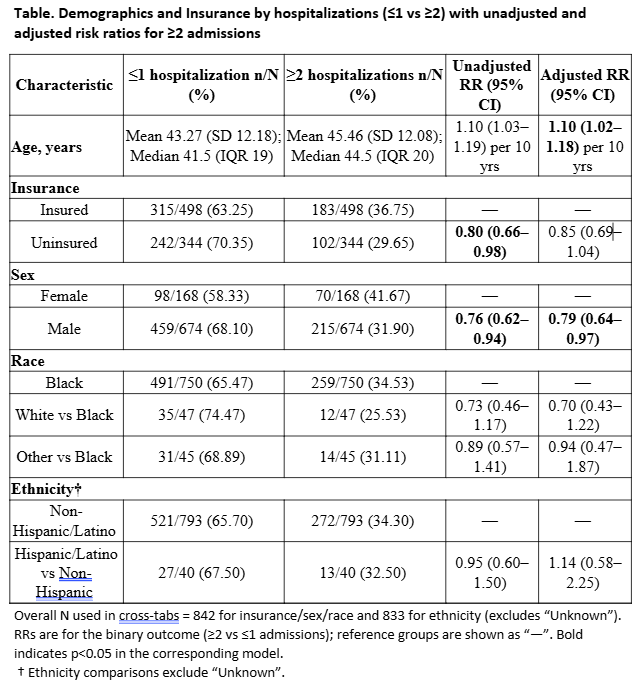
Among insured patients, 23% had commercial insurance, 17% Medicaid, 10% Medicare managed care, 7% Medicare, and 2% Medicaid managed care. Compared with insured patients, uninsured patients (n=344; 41%) were younger (mean 41 vs 46 years, p<0.001), more often male (83% vs 77%, p=0.03), more likely to identify as “Other” race (11% vs 2.4%, p<0.001) and Hispanic/Latino ethnicity (10% vs 1.2%, p<0.001). Uninsured patients had fewer hospitalizations (mean 1.35 vs 1.95; p=0.003). They were less likely to have ≥2 admissions (unadjusted risk ratio 0.80, 95%CI 0.66-0.98; Table); which was no longer significant after adjusting for demographics (adjusted risk ratio 0.85, 95%CI 0.69-1.04, p=0.08).
Conclusions
Over 40% of patients with advanced HIV at an urban, safety net healthcare system in a high HIV burden area in the Southern US were uninsured. Uninsured patients were younger, differed by race and ethnicity, and had fewer hospitalizations, which may reflect barriers to hospital use or reliance on outpatient services through Ryan White-funded care rather than lower morbidity. Increases in uninsurance could increase advanced HIV-associated morbidity by straining existing federal programs, limiting access to outpatient care, and driving more patients to seek care in overburdened hospitals with advanced HIV complications. Lawmakers and funders must urgently bolster Ryan White and safety-net financing to preserve access and prevent widening disparities in this vulnerable population.
Table or Figure