Background
The primary barrier to HIV cure is the latent viral reservoir, which persists despite antiretroviral therapy (ART). HIV activation could improve reservoir clearance, but previous approaches had unfavorable safety profiles. Interleukin-15 (IL-15), an immune modulatory cytokine, can activate HIV but has shown toxicity due to NK and CD8+ expansion. We developed CD4-targeted IL-15 (GS-huCD4-IL15) and a rhesus surrogate (GS-rhCD4-IL15) to selectively activate CD4+ T cells while minimizing NK and CD8+ activation. A combination with broadly neutralizing antibodies (bNAbs) which eliminate infected cells via cell-mediated cytotoxicity may enhance reservoir clearance and delay viral rebound upon ART interruption.
Methods
GS-huCD4-IL15 was tested in peripheral blood mononuclear cells (PBMCs) from ART-suppressed people with HIV (PWH). Supernatants were analyzed for HIV RNA and cells for Ki67 expression to quantify latency reversal and cellular activation. In vivo, SHIV-SF162P3–infected rhesus macaques (on ART for ≥8 months) were administered PGT121 (an HIV-specific bNAb) alone (n=15), PGT121+GS-rhCD4-IL15 (n=16), or PGT121+vesatolimod (VES, n=15), a Toll-like receptor 7 agonist previously shown to induce viral control with bNAbs in SHIV models. GS-rhCD4-IL15 (0.5 mg/kg IV) and VES (0.15 mg/kg PO) were administered every 2 weeks for 13 doses, with PGT121 (10 mg/kg IV) initiated at dose 4 for 10 doses. ART was discontinued 24 weeks after the final dose to assess viral rebound in an analytical treatment interruption (ATI). Plasma viral load, NK and T-cell activation, and intact proviral DNA in lymph node cells were assessed.
Results
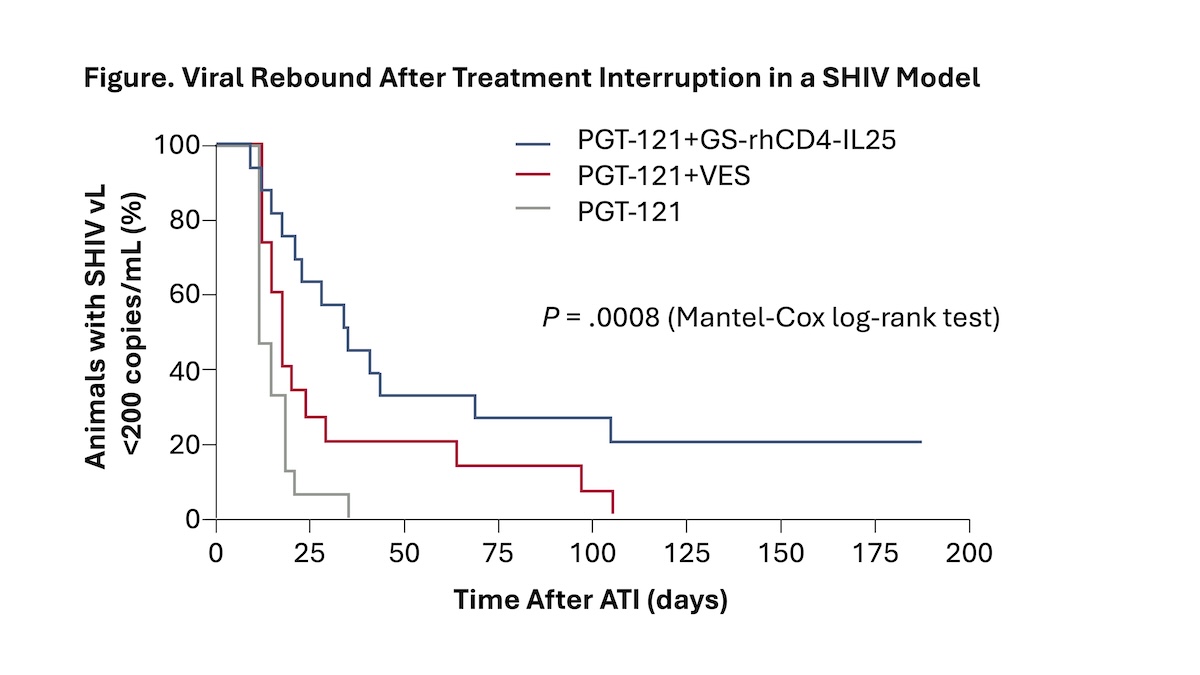
In PBMCs from PWH, GS-huCD4-IL15 induced HIV and Ki67 expression. In SHIV-infected macaques, GS-rhCD4-IL15 preferentially activated CD4⁺ T cells over CD8⁺ T and NK cells, confirming target selectivity, and induced HIV RNA in 12/16 animals. GS-rhCD4-IL15+PGT121 significantly (P=.04) reduced intact proviral DNA in lymph nodes relative to PGT121 alone and significantly delayed viral rebound after ART interruption (P=.0008) (Figure). In the CD4-IL15+PGT121 group, 3/16 animals maintained viral suppression for >8 months post ATI, and time-to-rebound correlated with reduction in lymph node intact SHIV DNA.
Conclusions
In a SHIV model, CD4-targeted IL-15 reactivated latent HIV and, when combined with bNAbs, reduced viral reservoirs and significantly delayed rebound after ART interruption. These findings support further evaluation of CD4-targeted IL-15 in HIV cure strategies.
Table or Figure