Background
The Mobile Outreach Retention and Engagement (MORE) program at Whitman-Walker Health offers care navigation, transportation, and optional home injections for PWH initiating CAB+RPV LA with VL >200 copies/mL or no medical visit in < 6 months. MORE previously demonstrated promising 4-month outcomes; this analysis evaluates the durability of these results at 10 months (M10).
Methods
In this effectiveness-implementation study, we compare the MORE cohort to a 2:1 matched (age/gender/race/ethnicity) clinic cohort receiving CAB+RPV LA. The primary outcome is CAB+RPV LA M10 persistence, secondary outcomes include on-time injection adherence (±7 days), viral suppression (<200 copies/mL), and home injection uptake at M10. We analyzed EMR data using descriptive statistics and logistic regression for predictors of persistence.
Results
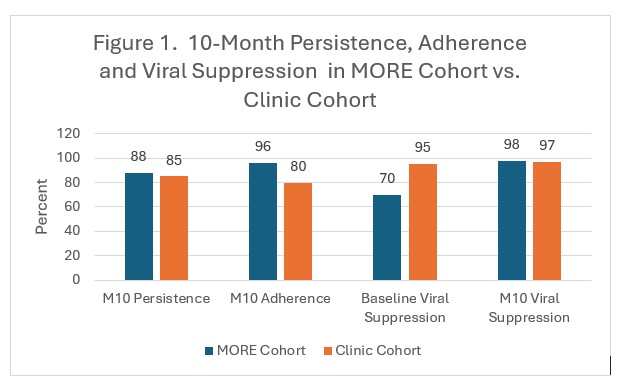
Of 54 participants initiating CAB+RPV LA through MORE (Nov 2023–Feb 2025), n=50 had ≥10 months since initiation. Median age was 49.6 years (IQR: 26); 40% cisgender women, 12% transgender women, 90% Black, and 84% publicly insured. The clinic cohort (n=100) was matched but baseline viremia (>200 copies/mL) was significantly higher in MORE vs. clinic cohort (30% vs. 5%, p<0.001). At 10M, persistence was 88% (44/50) for MORE and 86% (85/100) for clinic, p=0.804. MORE had 4 discontinuations due to side effects, 1 due to schedule, 1 relocation and 3 insurance lapses (3 restarts). The clinic cohort had 7 discontinuations due to side effects (1 restart), 4 missed injections (2 restarts), 4 insurance lapses (2 restarts), 1 relocation and 2 lost to follow-up. A logistic regression model for persistence, including age, race/ethnicity, ward, baseline VL, MORE, and adherence, was significant (X²(6)=61.3, p<0.001), but no individual predictors emerged. Among those who persisted, on-time adherence was higher in MORE (96%, 40/41) vs. clinic (80%, 66/82; p=0.011). At M10, 98% PWH in MORE vs. 97% in clinic cohort were virally suppressed with no confirmed virologic failures. Within MORE, home injection uptake was 62% (31/50) and more likely among those aged >40 (p=0.0359) and publicly insured (p=0.041).
Conclusions
Despite greater baseline viremia, PWH in MORE achieved comparable persistence, 98% viral suppression and superior adherence compared to the clinic cohort. Flexible, patient-centered support programs with the option for home injections can address logistical barriers, prevent disengagement, and improve clinical outcomes for PWH on CAB+RPV LA with prior adherence challenges.
Table or Figure