Background
The heterogeneity observed in cognitive symptoms among people with HIV (PWH) creates a challenge for translating research findings into effective clinical interventions. This study utilized a data-driven approach to identify cognitive subtypes and their clinical characteristics in an international sample of PWH who underwent cognitive assessment during acute or chronic infection.
Methods
Participants included PWH enrolled in an acute HIV (AHI) cohort in Thailand (RV254) or a chronic HIV US cohort (CHARTER and Washington University in St. Louis; WashU). Participants completed tests of verbal list learning and memory, psychomotor speed (Digit Symbol, Trails A), verbal fluency, and fine motor speed and dexterity (grooved pegboard). Individual test scores were scaled within each cohort prior to clustering. Kruskal-Wallis/Chi-square tests, adjusted for multiple comparisons, compared the clusters on demographics, HIV clinical indices, and health comorbidities.
Results
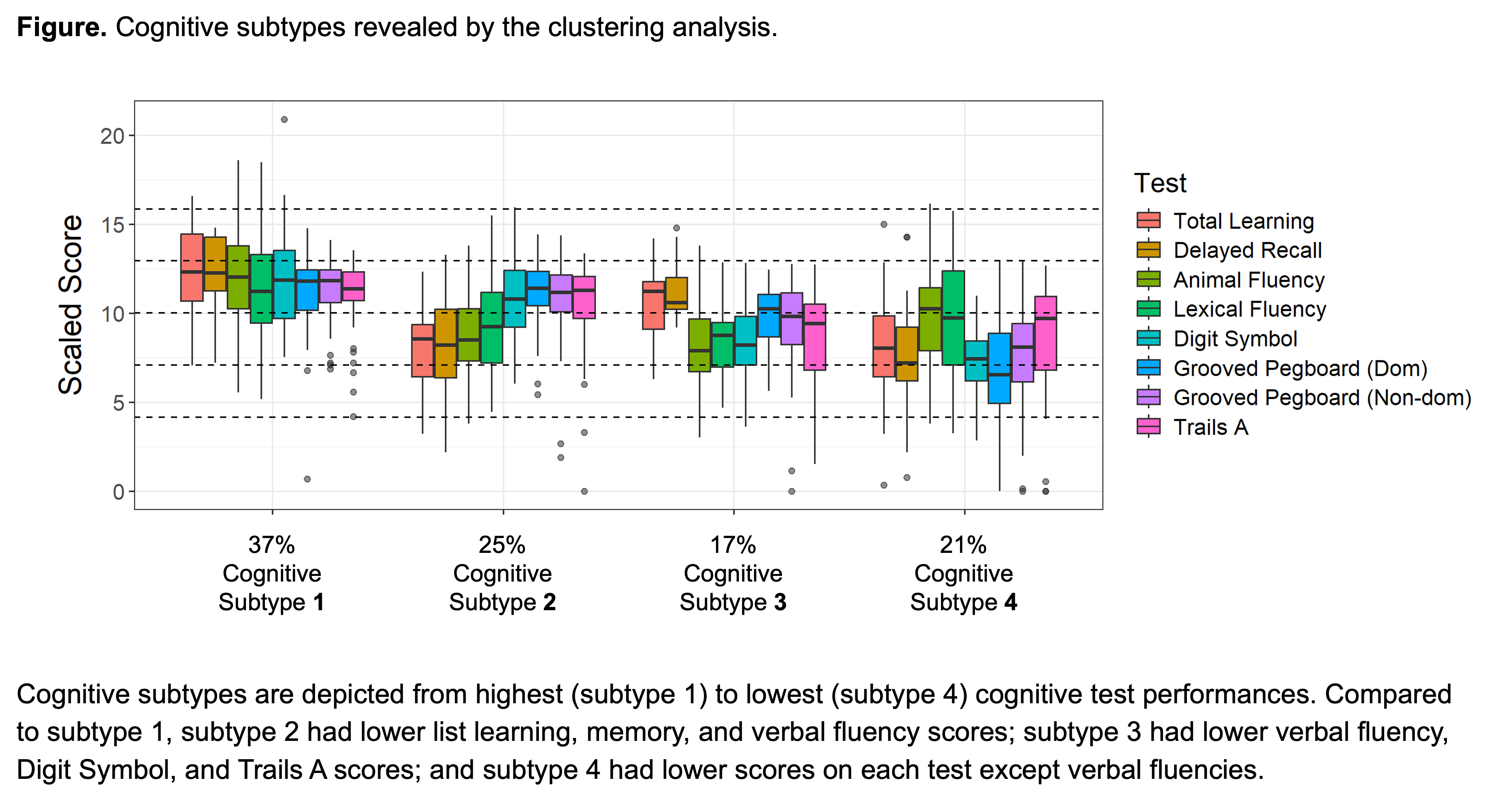
Participants were 213 PWH (AHI: n=33; CHARTER: n=80; WashU: n=100), 81% male, with a median age of 49.5 years (range: 18-76), 13 years of education, and nadir CD4+ T-cell count of 205/µL (range 0-1302). Clustering revealed four cognitive subtypes. Subtype 1 (37% of the sample) had the best performance on all cognitive tests. Subtype 2 (25%) had significantly lower list learning, memory and verbal fluency scores (ps<.05). By contrast, subtype 3 (17%) had lower verbal fluency, Trails A, and Digit Symbol scores, and subtype 4 (21%) had the lowest scores on each test except verbal fluency (ps<.05). The subtypes did not differ on age, sex, or nadir CD4. Participants with chronic infection (CHARTER and WashU) were more likely to be clustered into subtypes 1, 2, and 4, whereas participants with acute infection (RV254) were more likely to be in subtype 3. Compared to subtype 1, subtype 2 had lower hemoglobin levels and a higher proportion of Black individuals (ps<.05). Participants in subtypes 3 and 4 were more likely to be HCV seropositive and those in subtype 4 were more likely to have hypertension (ps<.05).
Conclusions
Individuals with chronic HIV were equally clustered into the highest- and lowest-performing subtypes, with the latter corresponding to more frequent health comorbidities. AHI participants clustered into the subtype defined by lower psychomotor performance, consistent with neurological perturbations observed in acute infection.
Table or Figure