Background
HIV preexposure prophylaxis (PrEP) is a highly efficacious intervention. Data on PrEP’s population-level effectiveness, how it may be changing over time, and how it varies in different populations are more limited. We evaluated the population-level effectiveness of PrEP among cisgender men and transgender and nonbinary people who have sex with men (MSM/TNB) with bacterial sexually transmitted infections (STI).
Methods
We analyzed routinely collected STI surveillance data for King County, WA, USA. We matched these data to WA State HIV surveillance data to identify persons living with HIV and to define a study population of MSM/TNB diagnosed with gonorrhea or syphilis from 1/1/2014-6/30/2024 who were not living with HIV at the time of STI diagnosis. Current PrEP use was obtained from partner services interviews through 3/31/2020 then from modified STI case report forms starting 4/1/2020. We calculated HIV incidence following STI diagnosis stratified by PrEP use, age, race/ethnicity, gender, and STI diagnosis, and HIV incidence rate ratios (IRR) by PrEP use. Persons included in the analysis contributed follow-up time from their initial STI diagnosis date until the date of HIV diagnosis, a subsequent STI diagnosis, or for at least 1 year. We used Cox proportional hazards models to estimate crude and adjusted hazard ratios (aHR) for PrEP use, race, STI diagnosis, and calendar year of STI diagnosis.
Results
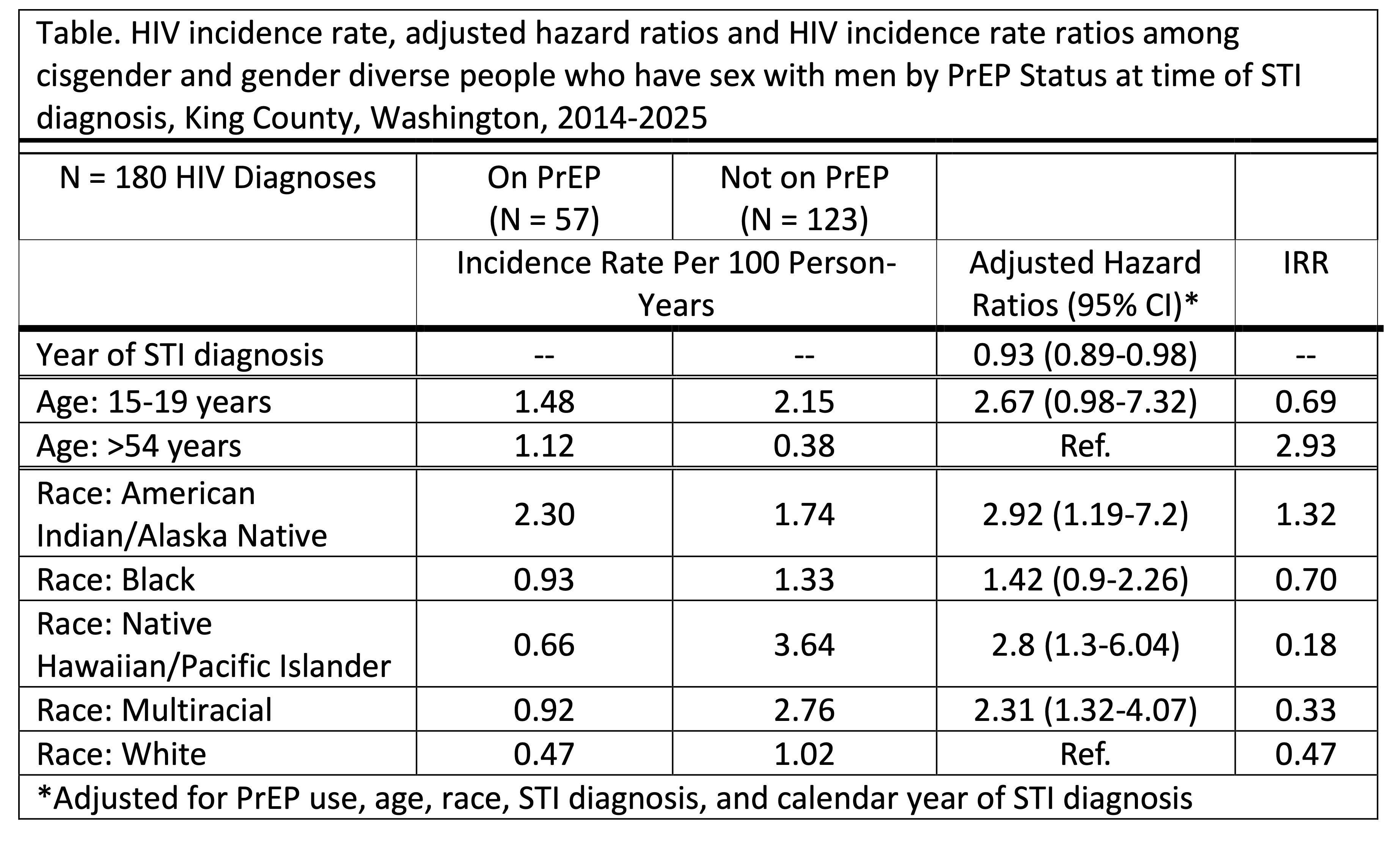
Over 23,558 person-years of follow-up, 180 people received new HIV diagnoses. HIV incidence was 0.46 per 100py in PrEP users vs 1.11 per 100py in non-PrEP users (aHR 0.52 [95% CI: 0.37-0.72]). HIV incidence was associated with year of STI diagnosis (aHR 0.93, 95% CI 0.89-0.98), and was higher in adolescents aged 15-19 (aHR 2.67), American Indian/Alaska Native (aHR 2.92), Black (aHR 1.42), and Native Hawaiian/Pacific Islander (aHR 2.8) people (Table). The HIV IRR comparing PrEP users versus nonusers demonstrated differential PrEP effectiveness by race, with an IRR among Black people of 0.7 compared to 0.47 and 0.33 in white and Multiracial people, respectively.
Conclusions
HIV incidence has declined 7% annually over time in King County and PrEP use was associated with a 50% reduction in the risk of HIV acquisition. However, HIV incidence remains highest in adolescents and people of color, and PrEP appears to be less effective in some MSM/TNB of color, reinforcing the need for targeted interventions to improve PrEP use and persistence in these key populations.
Table or Figure