Background
Malawi introduced 2-monthly long-acting injectable cabotegravir (CAB LA) for HIV pre-exposure prophylaxis (PrEP) in March 2024 to improve continued use and effectiveness compared to oral PrEP. The PathToScale initiative, led by Government of Malawi, with support of a consortium of partners, supported initial enrollment of clients onto CAB LA as part of the initiative’s 10-month lead-in phase.
Methods
CAB LA was introduced in 36 diverse facilities in Blantyre and Lilongwe, Malawi using national guidelines, from March 2024-January 2025. Facilities included public health clinics, private clinics, and key population-friendly drop-in centers, engaging diverse PrEP clients, including adolescent girls and young women, women who engage in sex work, men who have sex with men, men at higher risk for infection, and breastfeeding women, among others. The availability of CAB LA doses, per facility, were controlled to support health systems strengthening. Clients starting oral PrEP and CAB LA were passively enrolled into the PathToScale study and did not receive compensation. We assessed continuation rates at 1, 3, and 5 months among all clients initiating oral and CAB LA using de-identified data from the Ministry of Health facility-level PrEP cards and registers. Pregnant women were excluded from the analysis as they were enrolled through a separate safety study.
Results
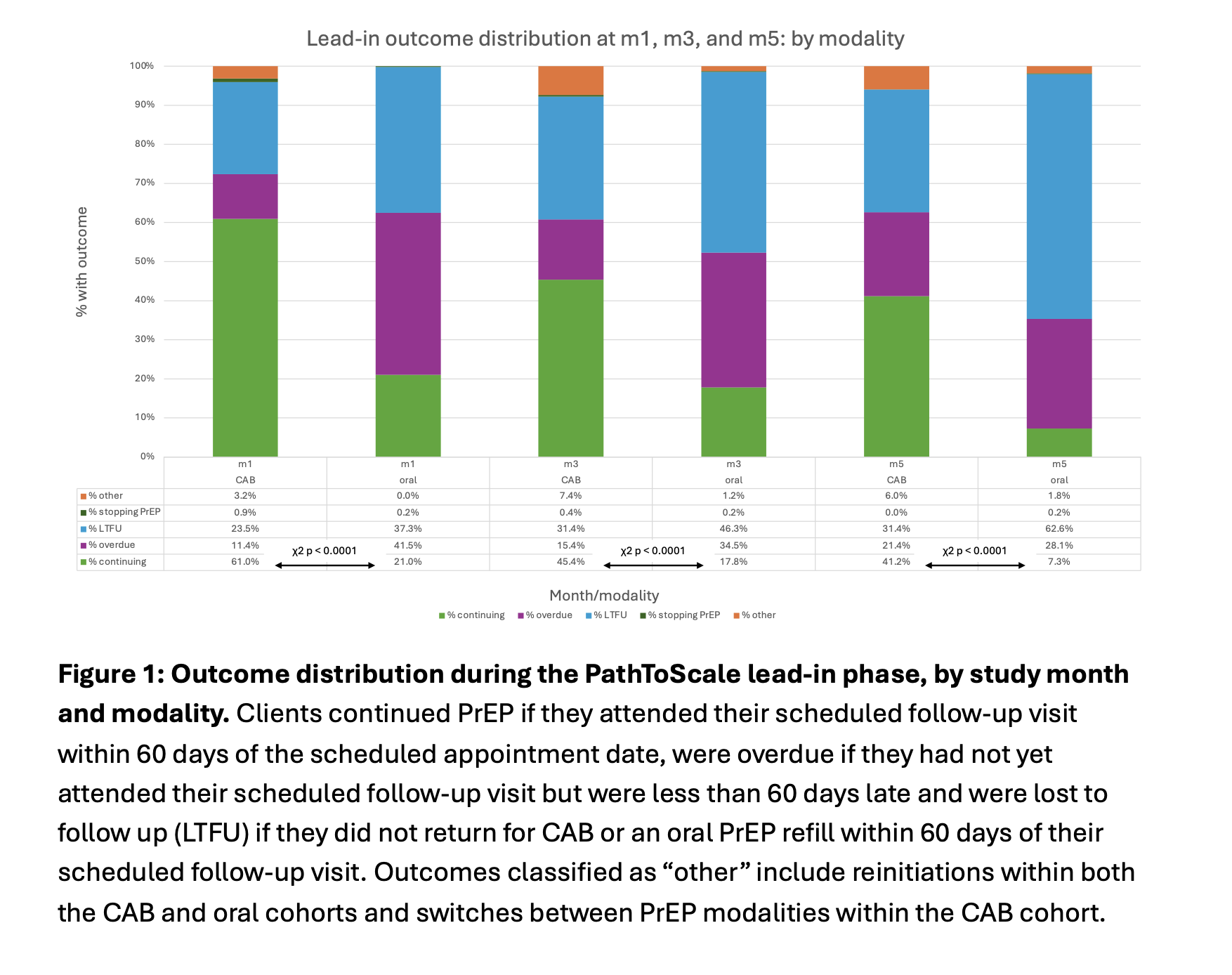
14,931 individuals initiated PrEP, including 1,243 on CAB LA and 13,688 on oral PrEP. Women comprised 66.5% of CAB LA initiators vs. 55.7% of oral PrEP (χ2 p < 0.0001). Uptake by PrEP type was similar across age strata. Continuation rates on CAB LA and oral PrEP were 61.0% and 21.0% at 1 month and 41.2% and 7.3% at 5 months, respectively (Figure 1). Oral PrEP continuation rates were higher among men at each month, while CAB LA continuation rates were similar between men and women until month 5, when females’ surpassed males’ (43.7% vs. 40.6%, χ2 p = 0.08). 15-24 year olds consistently had the lowest continuation rates for both CAB LA and oral PrEP, with rates generally increasing with age.
Conclusions
Clients on CAB LA demonstrated substantially higher continuation rates at each time period compared to those on oral PrEP across diverse facilities. Continuation on CAB LA in this programmatic setting, while robust, is lower than that observed in the registrational clinical trials. Support strategies for PrEP continuation remain critical, even in the era of LA PrEP, particularly among young people with high risk of HIV acquisition.
Table or Figure