Background
The influence of prior vaccination and infection on symptom resolution during acute COVID-19 remains unclear in the era of the omicron variant of SARS-CoV-2. Predictors of acute COVID-19 symptom resolution were identified among participants in the VISION Study, a prospective observational cohort study that enrolled adults in North Carolina (NC) with recent SARS-CoV-2 infection.
Methods
Participants were NC residents, age ≥18 y, who tested positive for SARS-CoV-2 within the prior 7 days. Daily online questionnaires that included items about 26 acute symptoms were completed over the first 14 days. Analysis was restricted to those whose symptoms started ≤ 7 days prior to enrollment. Time of symptom resolution was defined as the first of two consecutive days on which a participant reported no symptoms. The probability of symptom resolution was evaluated using inverse probability censoring weighted Kaplan-Meier curves. We computed the 14-day restricted mean survival time (RMST; average time to symptom resolution), RMST differences, and corresponding 95% bootstrap confidence intervals. We performed bivariate analyses for age, sex, race, ethnicity, body mass index, comorbidities, urbanicity, smoking status, vaccination recency, prior infections, and hybrid immunity (prior infections & vaccination status).
Results
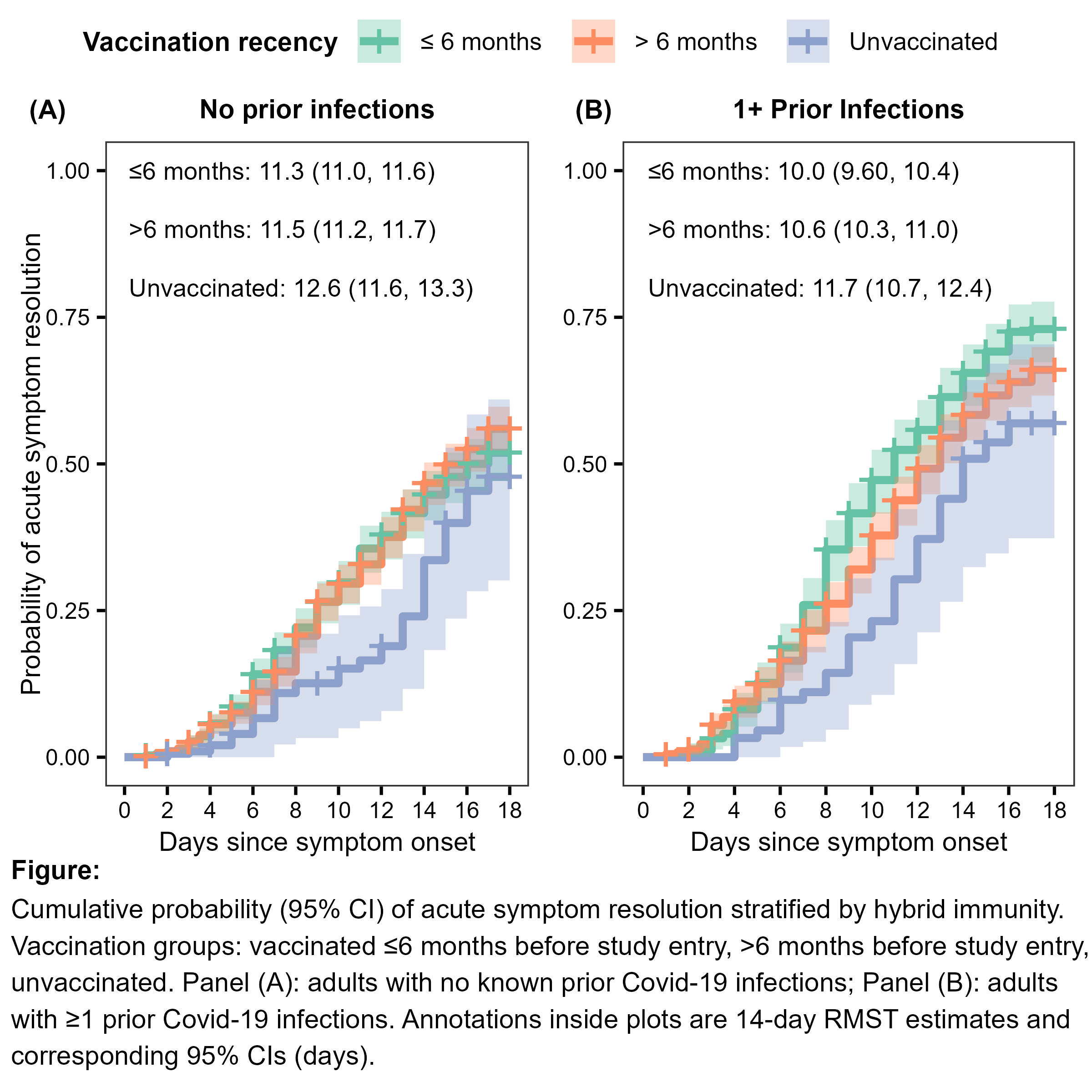
Among 2,731 eligible participants, median age was 47 y (IQR: 36, 61); 73% were female; 38% received a Covid-19 vaccine within 6 months of study entry; 57% reported no prior SARS-CoV-2 infection; 13% had presumed hybrid immunity (prior vaccination within 6 months of study entry and at least one prior infection) and 2.6% reported neither prior vaccination nor infection. The overall estimated cumulative probability of symptom resolution 14 days from symptom onset was 52% (CI: 50%, 54%) and was higher for those with presumed hybrid immunity at 66% (CI: 60%, 70%) compared to 34% (CI: 18%, 46%) for those with neither prior vaccination nor prior infection. The estimated RMST for symptom resolution for those with hybrid immunity was 2.5 days (CI: 1.5, 3.4) shorter than that of those with neither prior vaccination nor infection (Figure).
Conclusions
Unvaccinated adults, especially those with no prior infections, had the lowest cumulative probability of acute symptom resolution compared to those who were recently vaccinated and had at least one prior infection. Our results signal a beneficial role of vaccination on symptom resolution for those with prior SARS-CoV-2 infections.
Table or Figure