Background
Long-acting injectable (LAI) antiretroviral therapy (ART) has the potential to mitigate multi-level barriers to HIV treatment adherence for youth living with HIV (YLHIV) including the shift to adult care, clinic wait times, stigma, and daily pill burden. However, LAI options have not yet been made widely available in South Africa where the HIV burden is high and preferences for long-acting ART delivery modalities to YLHIV remain understudied.
Methods
In May-July 2025, guided by formative qualitative work, we implemented a structured survey and discrete choice experiment to characterize preferences for the delivery of LAI ART with YLHIV in the Western Cape. Respondents completed 12 choice tasks considering six distinct attributes: modality, service type, clinic hours, overall visit time, bundled services, and side effects. Bayesian logistic regression models fit using MCMC algorithms were used to derive part-worth utilities (β) and 95% credible intervals (CI) from the posterior means for each feature. We evaluated preference heterogeneity through stratified analyses across subgroups defined by age, sex, and prior LAI experience.
Results
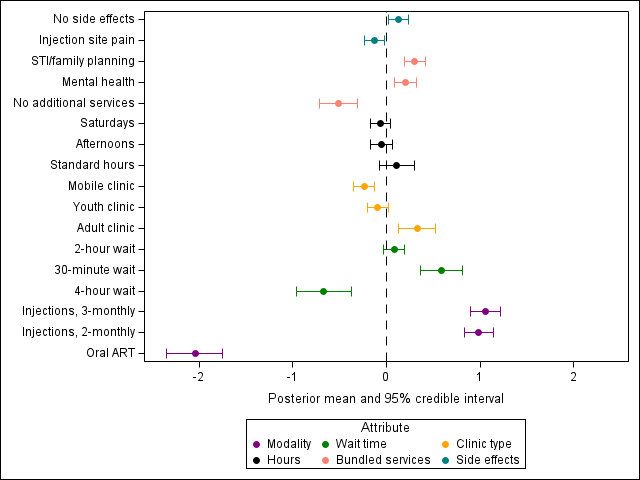
A total of 94 YLHIV [median age: 23 (IQR 21-25)] completed the survey, of whom 12 (13%) were non-virally suppressed and 54 (57%) had previously taken LAI CAB/RPV. Overall, YLHIV significantly favored 2-monthly (β=0.99 95%CI 0.83,1.15) and 3-monthly (β=1.05 95%CI 0.90,1.21) injections (Figure); as well as the integration of bundled services including STI/family planning (β=0.30 95%CI 0.19,0.42) and mental health services (β=0.21 95%CI 0.09,0.32). YLHIV disfavored mobile service delivery (β=-0.24 95%CI -0.35,-0.13) and longer wait times (β=-0.67 95%CI -0.96,-0.37), but were agnostic to expanded clinic hours including on Saturdays and afternoons. Stratified analyses suggested a stronger preference for LAIs among males relative to females (males: β=1.33 95%CI 1.17, 1.67; females: β=0.99, 95%CI: 0.80-1.17). Preferences across attributes and levels were comparable by age and by prior LAI history.
Conclusions
YLHIV demonstrated a strong preference for LAI ART relative to oral ART, including among those who had previously taken CAB/RPV. Mobile service delivery was largely disfavored, suggesting that YLHIV may prioritize stigma mitigation and confidentiality over convenience. Pre-implementation research studying optimal LAI-ART implementation for YLHIV is central to rapidly optimizing both the equity and real-world effectiveness of LAIs in South Africa and beyond.
Table or Figure