Background
People with HIV (PWH) disproportionately experience homelessness and unstable housing (HUH), which is associated with difficulties accessing care and worse clinical outcomes. Limited data are available on how housing status among PWH varies by location or over time.
Methods
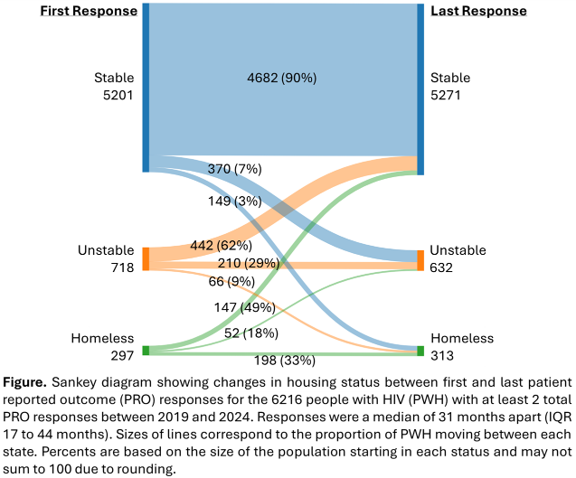
We used data from the Center for AIDS Research Network of Integrated Clinic Systems (CNICS), a cohort of PWH in clinical care. CNICS combines data from electronic medical records with patient-reported outcomes (PROs) collected every ~6 months at clinic visits. Housing status was assessed by asking respondents to mark all the places they spent a night in the past month and was defined as stable (owns, rents, long-term care), homeless (shelter, car, hotel, outside), or unstable (couch surfing, multiple locations, other). We assessed demographic differences between PWH experiencing HUH vs stable housing with chi-squared tests. We calculated the prevalence of homelessness at each clinic compared to the prevalence of homelessness in each clinic’s county per the 2024 Annual Homelessness Assessment Report to Congress and US census data. For participants with multiple PROs, we tracked how housing status changed between the first and most recent PRO.
Results
Between 2019 and 2024, 25701 total PROs were recorded from 10654 PWH at 8 sites. On their most recent PRO, 564 (5%) PWH were homeless and 1206 (11%) were unstably housed; estimates from PROs in 2024 were similar (188/3650 (5%) homeless, 426 (12%) unstable). PWH experiencing HUH were more likely to identify as a racial or gender minority and to have injection drug use as an HIV risk factor and were less likely to report current antiretroviral use or to have a suppressed viral load on last report (p <0.01 for all). The proportion of PWH at each site experiencing HUH on their last PRO ranged from 8-31%. The prevalence of homelessness among PWH ranged from 1.8-52 times higher than county-level population estimates, with a greater difference in areas with a lower prevalence of homelessness. A majority of PWH remained in the same housing status over time, but a large minority (20%) moved between statuses, resulting in a stable prevalence of HUH over time (Fig).
Conclusions
PWH across the US experience a disproportionately high burden of HUH. Housing status frequently changed. In this analysis, the influx of people newly experiencing HUH roughly balanced the efflux of those moving into stable housing. Continued access to housing services could improve outcomes for PWH.
Table or Figure