Background
Cabotegravir long-acting (CAB-LA) was approved by the United States Food and Drug Administration for human immunodeficiency virus 1 (HIV-1) pre-exposure prophylaxis (PrEP) in December 2021. This PrEPFACTS analysis evaluated real-world adherence and persistence patterns for CAB-LA compared to oral PrEP in new PrEP initiators.
Methods
PrEPFACTS was a retrospective US cohort study using data from the Komodo Research Database (01/Dec/2020-30/Sept/2024). Individuals ≥12 years old who received ≥1 CAB-LA injection or oral PrEP fill (first claim defined index date), had ≥12 months of continuous insurance eligibility before (baseline) and ≥6 months after index were included. Individuals with HIV-1 or HIV-2 diagnosis or receiving any PrEP or ≥60 days of non-PrEP antiretroviral therapy (ART) during baseline were excluded. Each individual in the CAB-LA cohort was exact matched to 4 oral PrEP users by age group and index quarter/year. Standardized mortality ratio (SMR) weighting was applied after matching to ensure comparability between cohorts. Adherence was described using proportion of days covered (PDC) from index to therapy discontinuation, with PDC ≥90% considered adherent. Discontinuation was defined as a gap of ≥91 days after the first CAB-LA injection or ≥121 days after subsequent injections, or ≥60 days since exhaustion of previous supply of oral PrEP. Logistic and Cox proportional hazards regression models were used to determine the odds of adherence and risk of discontinuation, respectively. SMR-weighted Kaplan–Meier analysis was used to estimate days until discontinuation (persistence).
Results
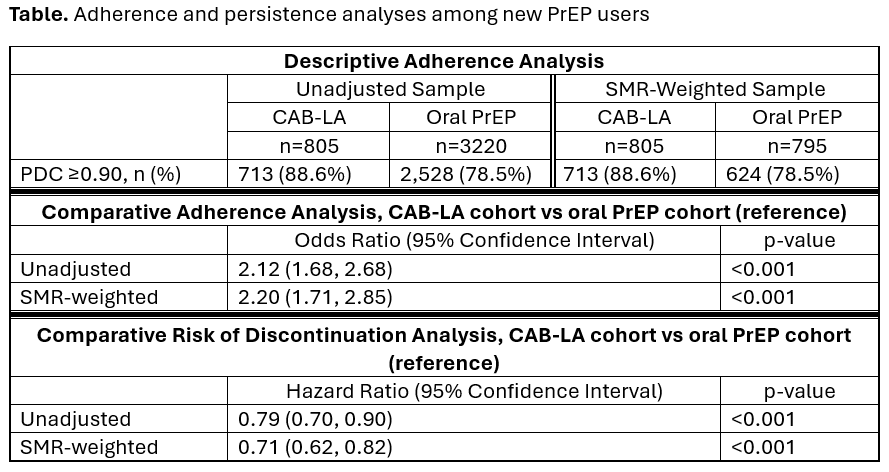
The CAB-LA cohort (N=805) had a median (interquartile range, IQR) age of 33 (27,44) with primarily commercial (48%) and Medicaid (48%) insurances. Sixty-seven percent were male, 31% White, and 26% Black. The oral PrEP cohort (N=3220) had a median (IQR) age of 33 (26,43) were primarily commercially insured (76%), male (90%), and White (34%). After SMR-weighting, patient characteristics were similar between cohorts. A significantly larger proportion of the CAB-LA cohort was adherent compared to the oral PrEP cohort (Table). In new PrEP users with ≥2 injections/fills, median (95% confidence interval) persistence was 374 (279, 436) days on CAB-LA and 225 (190, 263) days on oral PrEP. The risk of discontinuation was significantly lower in the CAB-LA cohort (Table).
Conclusions
New PrEP initiators using CAB-LA exhibit improved adherence and persistence relative to those using oral PrEP.
Table or Figure