Background
Well-being-adjusted life-years (WALYs), an emerging metric, broaden quality-adjusted life-years (QALYs) by considering factors relevant for health policy decision making that extend beyond health-related quality-of-life (HRQoL). We compared results and inferences for decision making using WALYs versus QALYs in an allocative efficiency analysis of HIV-related interventions in southern African countries.
Methods
Using a validated simulation of HIV transmission and progression in Zimbabwe, Eswatini, and Kwazulu-Natal in South Africa, we simulated the impact of scaling-up various intervention combinations on HIV incidence and variants of adjusted life expectancy. QALYs were assessed per usual methods. To assess WALYs, HIV-related disutilities beyond HRQoL (e.g. stigma) were estimated empirically from stakeholders using a trade-off-based procedure, where participants indicated the proportion of remaining life they would give up to avoid HIV even if treatment eliminated all HIV-related HRQoL impairments. Interventions modeled were selected based on greatest interest to stakeholders, including new interventions such as long-acting antiretroviral therapy (LA ART) as well as additional scale-ups of standard interventions (e.g. defaulter tracing). Cost, effectiveness, retention, and coverage inputs were based on literature, stakeholder expertise, and country-specific surveillance data. Outcomes were infections averted, QALYs gained, WALYs gained, and incremental cost-effectiveness ratios (ICERs) of cost per QALY gained and cost per WALY gained.
Results
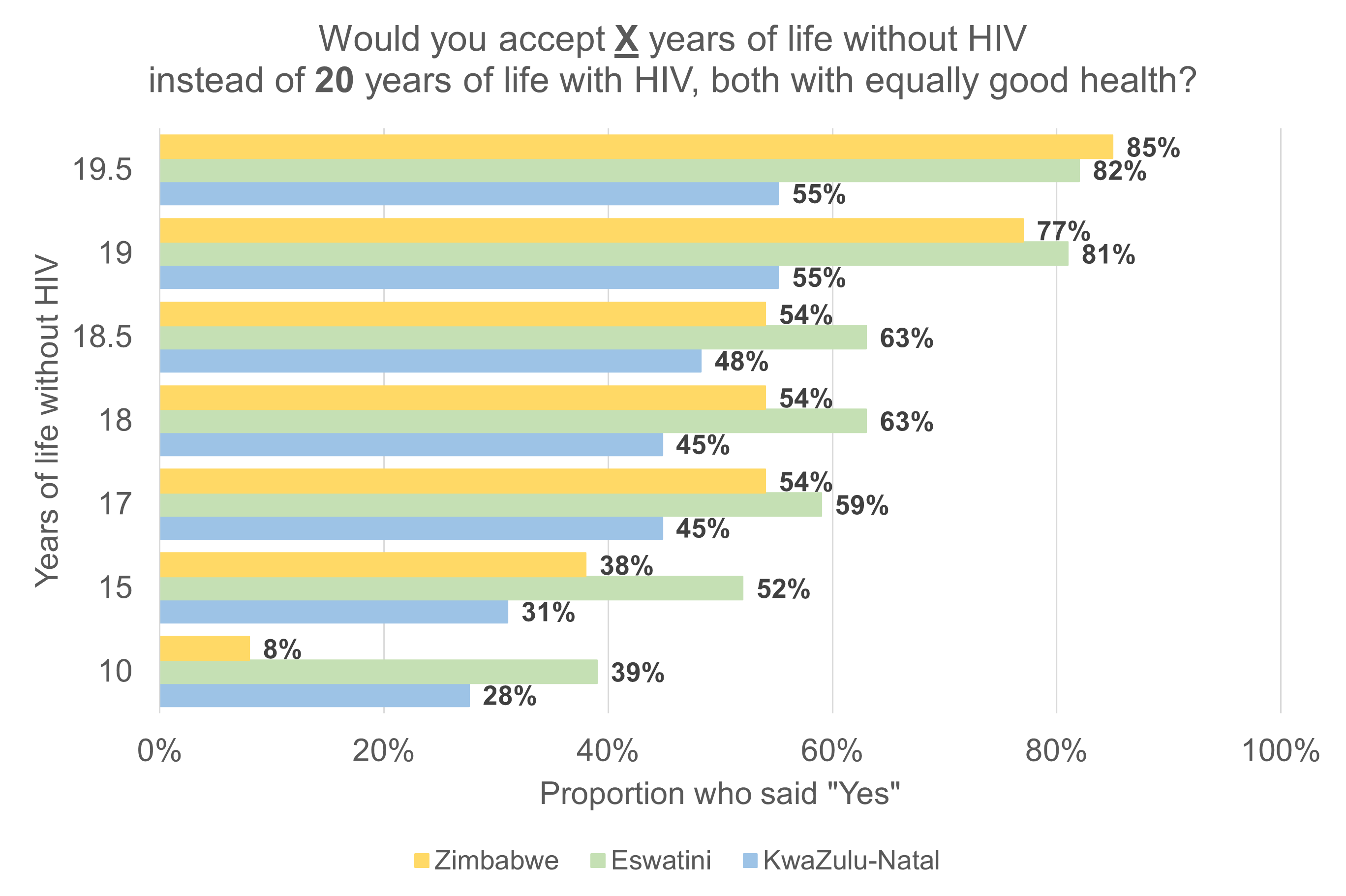
Most people were willing to trade-off substantial proportions of their remaining lives to avoid HIV even without impact on HRQoL, with mean beyond-HRQoL disutilities of 0.17, 0.20, and 0.25 for Kwazulu-Natal, Zimbabwe, and Eswatini respectively (Figure). In Zimbabwe, results showed that offering LA ART to people on oral ART averted 18,250 additional infections and added 13,870 additional QALYs through 2030 at an ICER of $1,490/QALY. In contrast, LA ART added 32,120 additional WALYs through 2030 at an ICER of $650/WALY. Using WALYs rather than QALYs preserved the rank-order of intervention ICERs, but interventions disproportionately impacting prevention rather than treatment sustained greater ICER improvements. Results were broadly consistent in the other two settings.
Conclusions
Using WALYs rather than QALYs produced different ICERs for interventions preventing HIV and may yield alternative inferences for decision-making.
Table or Figure