Background
The Southeastern region has the highest HIV incidence and longest times to achieving and sustaining viral suppression (VS) in the U.S. To address these gaps in Alabama, we initiated COAST-AL, a combination intervention including: data-driven community-based HIV testing, community-based needs assessments to expedite linkage, and a rapid HIV treatment initiation program with the Mobile County Health Department and affiliated clinics serving urban and rural areas with the aims of evaluating both effectiveness and impact (type 2 hybrid implementation-effectiveness design).
Methods
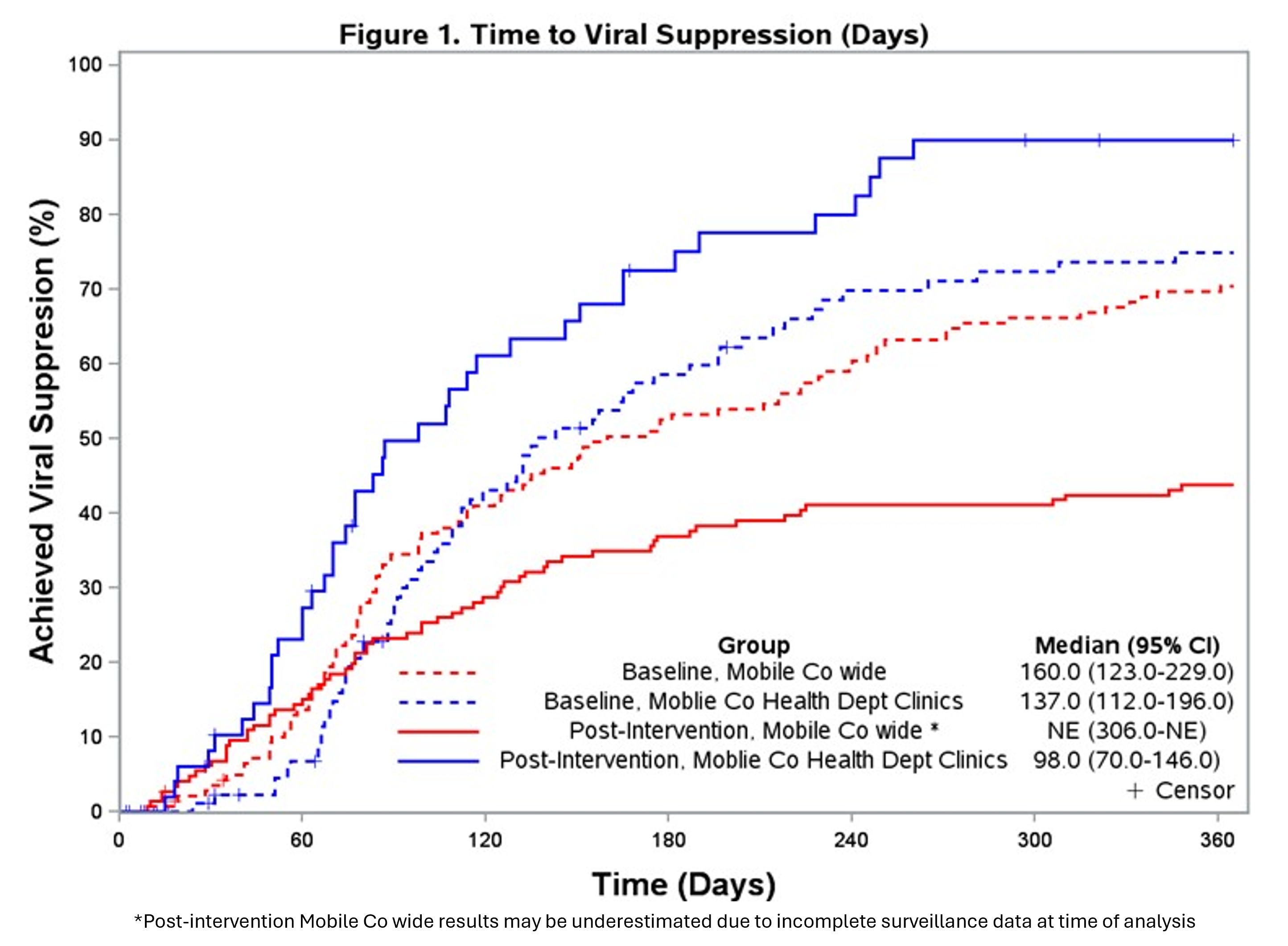
Using surveillance data, rates of HIV incidence in Mobile County and time to VS pre-implementation (May 2020-April 2022) and post-implementation (Nov 2023-Sept 2025) were estimated for Mobile County Health Department clinics and county-wide. Time to VS (number of days from HIV diagnosis to date of first recorded viral load less than 200 copies/mL) was assessed via Kaplan-Meier curves and Cox regression to describe time to VS during pre and post intervention time periods in the clinic and county.
Results
Mobile County Health Department clinics served 80% of people newly diagnosed with HIV in the county. During the pre-intervention period, median time in days to VS (95% CI) in clinics (n=77) and Mobile County (n=141) was 137 (112-196) and 160 (123-229), respectively. Post-intervention, time to VS improved at the clinic level (n=65) to 98 days (70-146) [Figure 1]. Persons diagnosed with HIV at Mobile County clinics in the post-intervention period had faster time to VS than clinics (HR: 1.72, 95% CI: 1.17-2.53) and Mobile County (HR: 1.97, 95% CI: 1.37-2.84) during the pre-intervention period. Preliminary analysis of HIV incidence rates for the county increased from 3.43 per 10k residents to 3.57 per 10k residents over the same time periods.
Conclusions
Implementation of a combination intervention with an academic-public health-community partnership to increase testing, expedite linkage and initiation of ART has shown decrease in time to VS at the clinic level highlighting intervention effectiveness. More modest impacts in time to VS and rise in incidence noted at the county level inform the next phases of the work to engage additional community entities in testing, linkage and rapid start programming.
Table or Figure