Background
PURPOSE 1 (NCT04994509) is a Phase 3, double-blind, randomized, controlled trial assessing the efficacy of lenacapavir (LEN) and emtricitabine plus tenofovir alafenamide (F/TAF) for pre-exposure prophylaxis (PrEP) in adolescent girls and young women. Although LEN was 100% efficacious at the primary analysis, F/TAF HIV incidence was similar to the background HIV incidence rate. Case-control analysis within the F/TAF group demonstrated a 9-fold lower likelihood of HIV acquisition in participants with medium or high adherence compared with those with low adherence. Here, we provide an in-depth laboratory analysis of incident HIV cases in the F/TAF group, including adherence, resistance, and timing of seroconversion.
Methods
HIV testing at each study visit included rapid and central laboratory 4th-generation antibody/antigen tests. HIV-1 RNA testing was conducted from the visit prior to seroconversion using archived samples. Adherence was assessed by measuring tenofovir diphosphate (TFV-DP) concentrations in dried blood spots (DBS). Genotypic resistance testing was performed for participants with HIV-1 RNA concentration > 200 copies/mL.
Results
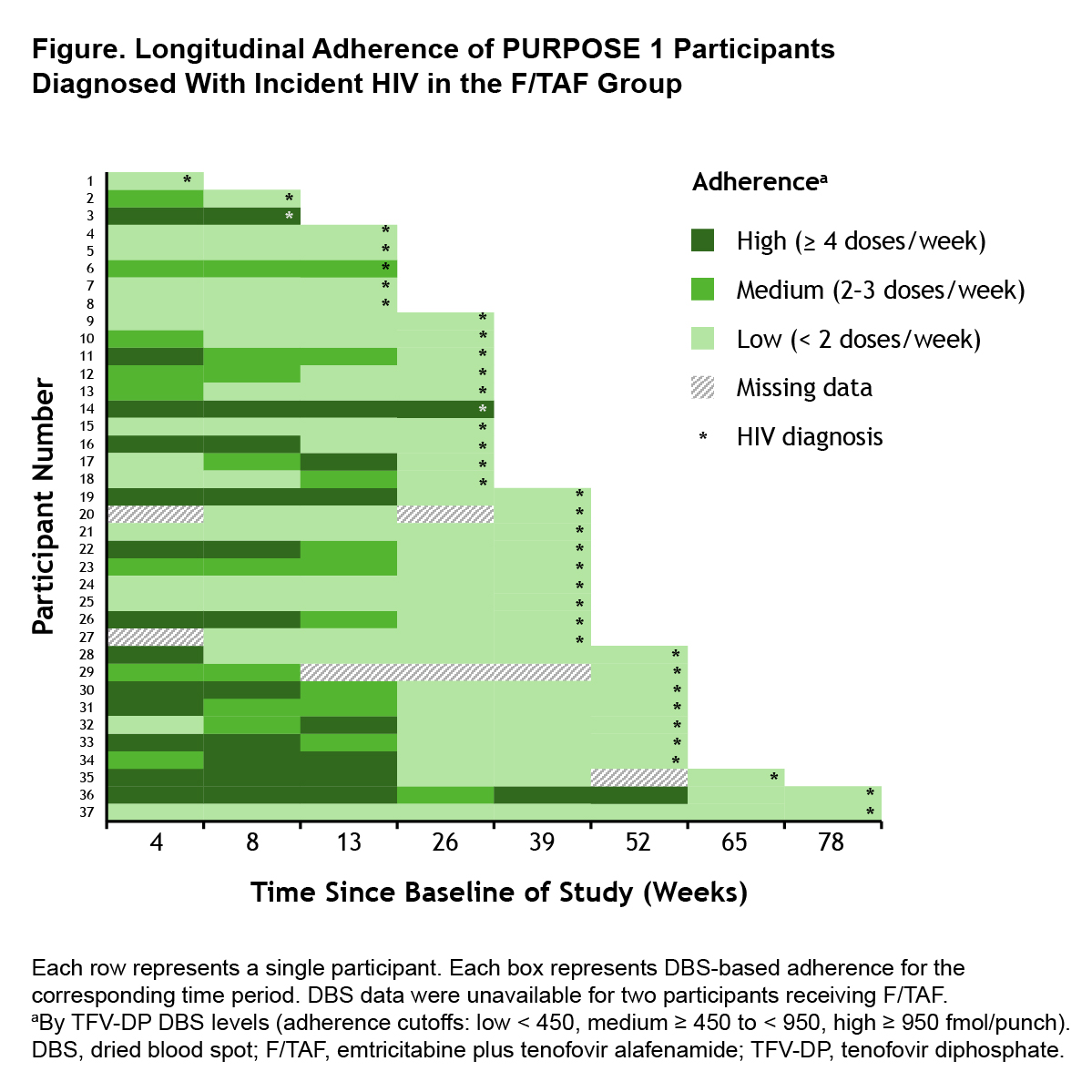
DBS adherence data were available for 37/39 incident cases in the F/TAF group. Among these, 35/37 had DBS TFV-DP concentrations indicating suboptimal or nonadherence. Longitudinal adherence patterns are shown in the Figure. Of the participants with high adherence, one had no resistance-associated mutations (RAMs) at the time of diagnosis and the other had M184I reverse transcriptase (RT) inhibitor RAM, K65R RT inhibitor RAM, and Y188L non-nucleoside RT inhibitor RAM at diagnosis, consistent with transmitted drug resistance (TDR). HIV-1 RNA was positive one visit prior to seroconversion in seven F/TAF participants; DBS indicated suboptimal adherence at the time of RNA detection for six of these.
Conclusions
Nearly all incident HIV cases in participants receiving F/TAF in PURPOSE 1 were attributable to low oral PrEP adherence, with one additional case likely explained by TDR. Emergence of antiretroviral resistance was rare. A minority of participants had brief delays in seroconversion. Taken together, these results suggest that HIV infections in PURPOSE 1 occurred almost always in the context of nonadherence to F/TAF, with rare emergence of HIV resistance and low risk of HIV diagnosis delay. Thus, F/TAF could be important for women who prefer a daily oral HIV prevention option.
Table or Figure