Background
Globally, successful strategies to engage high-risk heterosexual men in HIV prevention are scarce, resulting in limited access and uptake. Barbershops offer a potential venue for HIV prevention.
Methods
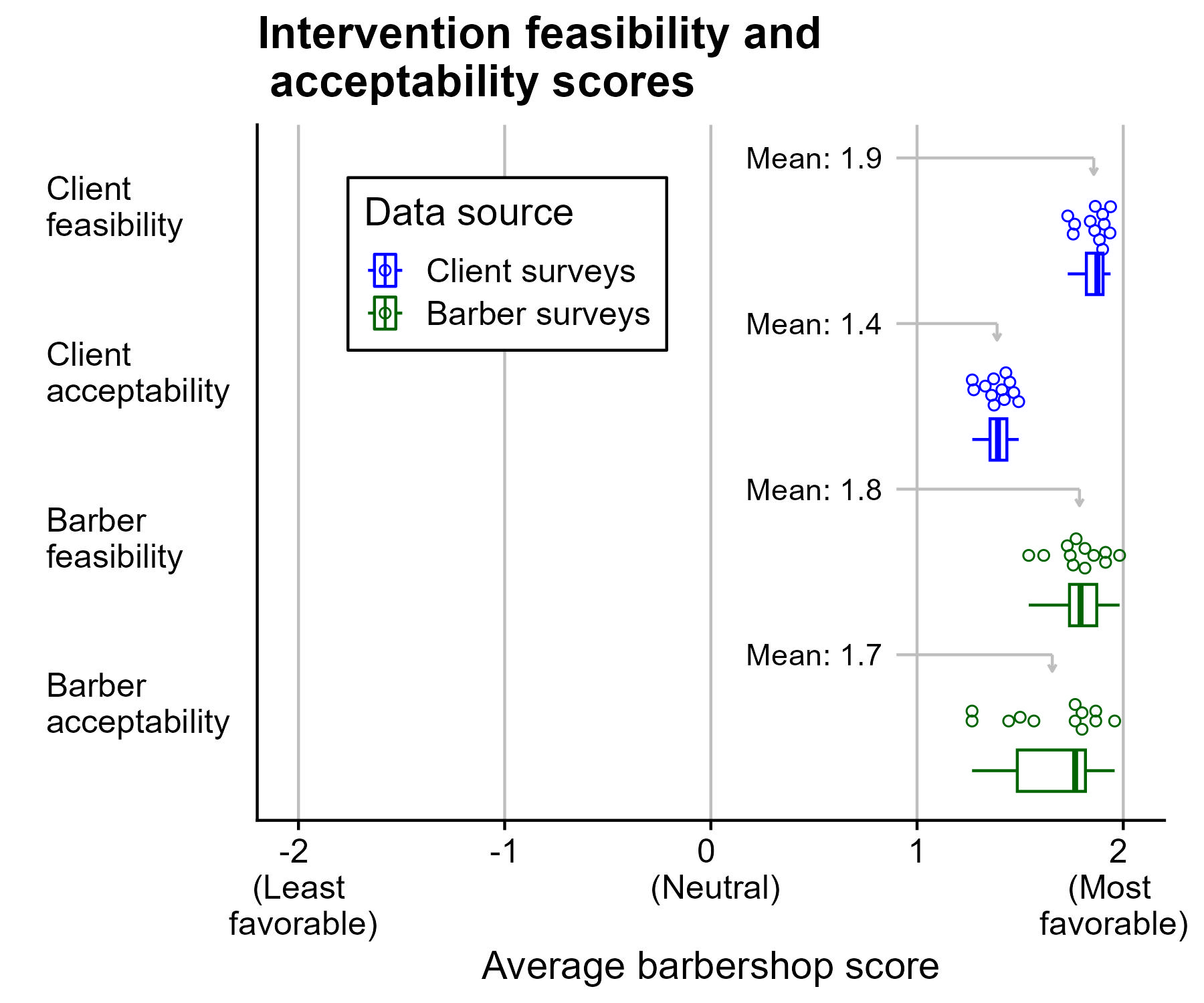
We implemented a barbershop-based HIV prevention intervention in the Kalangala district fishing communities. Barbershops were recruited and randomized 2:1 to the intervention (n=12) or standard of care (SOC) (n=6). Intervention barbers were trained to deliver status-neutral HIV education, distribute HIV self-test kits (also per request for sex partners), and facilitate peer-support group discussions. SOC included referral to routine HIV prevention services at HIV care centers. Clients completed STI testing and surveys on the intervention and HIV testing behaviors at Week 26 and 52. We assessed feasibility and acceptability of the intervention for barbers and clients using composite scores ranging from -2 (least favorable) to 2 (most favorable) based on an average of Likert scales. We also compared HIV testing between arms, adjusting for barbershop characteristics.
Results
21 barbers were recruited and trained, and 15 received intervention-specific training. Barbers recruited 250 male clients (median of 14 clients per shop) between March and June 2024. Clients had a median age of 29 years (IQR 24,35). Over three months prior to enrollment, clients had a median of 4 (IQR 2,6) sexual partners,188/250 (75%) reported transactional sex, and 45/250 (18%) had a treatable STI at enrollment. Week 52 visits were completed by 239/250 (96%) clients: 157/166 (95%) in the intervention arm and 82/84 (98%) in the SOC arm. Barber delivery of the intervention components by Week 52 was high: 163/163 (100%) in the intervention arm received HIV education, 150/163 (92%) took a self-test kit, and 162/163 (99%) attended a peer group session. The mean intervention feasibility score was 1.9 (95% CI 1.8,1.9) for clients and 1.8 (95% CI 1.7,1.8) for barbers, and acceptability was 1.4 (95% CI 1.4,1.4) for clients and 1.7 (95% CI 1.6,1.8) for barbers. 126/155 (81%) clients in the intervention arm self-initiated HIV testing throughout the study vs. 27/82 (33%) in the SOC arm (adjusted increase of 47%, 95% CI: 34%,61%, p<.001). No participants acquired HIV during the trial.
Conclusions
The barbershop-based intervention was highly feasible and acceptable, and led to a substantial increase in self-initiated HIV testing. Further evaluation of barbershops as venues for engagement with HIV services is warranted.
Table or Figure