Background
Doxycycline post-exposure prophylaxis (DPEP) is highly effective at preventing bacterial sexually transmitted infections (STIs) among men who have sex with men and trans women (MSMTW), but its impact on antibiotic prescribing is unclear. We assessed changes in patterns of antibiotic use among MSMTW at a Boston sexual health clinic that implemented DPEP in spring 2023. We hypothesized that total antibiotic exposure would be higher among patients receiving DPEP despite decreases in prescriptions for new bacterial STIs, while patients not on DPEP would experience a net decrease in antibiotic exposure due to less frequent treatment for bacterial STIs.
Methods
We conducted a retrospective cohort study of patients who were ≥18 years old, identified as MSMTW, and had ≥2 visits at the Massachusetts General Hospital Sexual Health Clinic (SHC) after 1 January 2023. Using a negative binomial regression, we assessed the total number of antibiotic prescriptions and the number of non-DPEP doxycycline, ceftriaxone, and penicillin prescriptions received by current, eventual, and never DPEP users. Explanatory variables included calendar time, if a patient was ever prescribed DPEP, if a patient was currently prescribed DPEP, and the proportion of current DPEP users who had newly started DPEP at a given time step.
Results
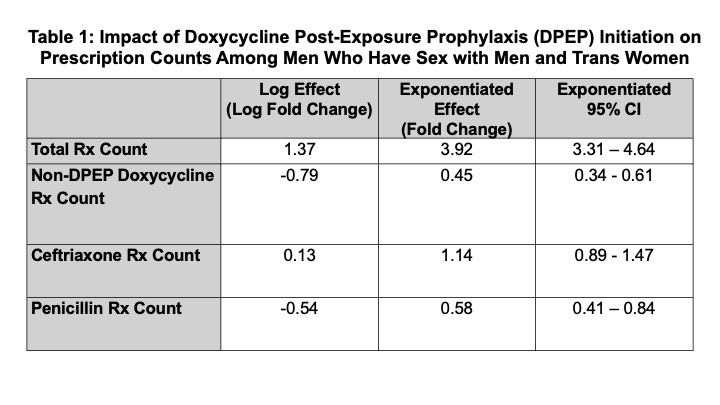
Among 1465 patients who met our inclusion criteria, 939 started DPEP between 1 September 2022 and 30 April 2025. DPEP users received 3.92 (95% CI 3.31 – 4.64) times the number of total antibiotic prescriptions of non-users, controlling for differences between eventual and never DPEP users. DPEP users received 0.45 (95% CI 0.34 – 0.61) times the number of non-DPEP doxycycline prescriptions, 0.59 (95% CI 0.41 – 0.84) times the number of penicillin prescriptions, and 1.14 (95% CI 0.89 – 1.47) times the number of ceftriaxone prescriptions of non-users. We did not see clear evidence of a net change in the number of antibiotic prescriptions among MSMTW who were not prescribed DPEP.
Conclusions
Even when accounting for declines in antibiotic prescriptions for STI treatment, DPEP users received more antibiotic prescriptions than people who were not prescribed DPEP. DPEP initiation decreased non-DPEP doxycycline and penicillin prescriptions but did not impact ceftriaxone prescriptions. We did not observe decreased rates of antibiotic use among MSMTW that were not taking DPEP, though this assessment was limited by incomplete information about SHC patients’ sexual networks.
Table or Figure