Background
Incomplete HIV transcripts far outnumber completed or spliced HIV RNA in ART-suppressed PWH, but it is not clear which HIV transcripts are associated with immune activation and/or immune clearance markers in this setting. Efavirenz (EFV) may induce pyroptosis of HIV-expressing cells, but its relationship to HIV transcriptional activity is also unclear.
Methods
We measured initiated (TAR), 5’elongated (LTR-pre-Gag), mid/unspliced (Pol), distal (Nef), completed (U3-polyA), and multiply spliced (Tat-Rev) HIV RNA levels in PBMC from ART-suppressed PWH using RT-ddPCR and assessed their relationship to both EFV use and the relative abundance of plasma immunologic proteins using the Olink Inflammation Explore platform (358 measurable proteins) after adjustment for age, sex, and CD4 count, with false discovery rate (FDR) adjustment (Storey’s Q).
Results
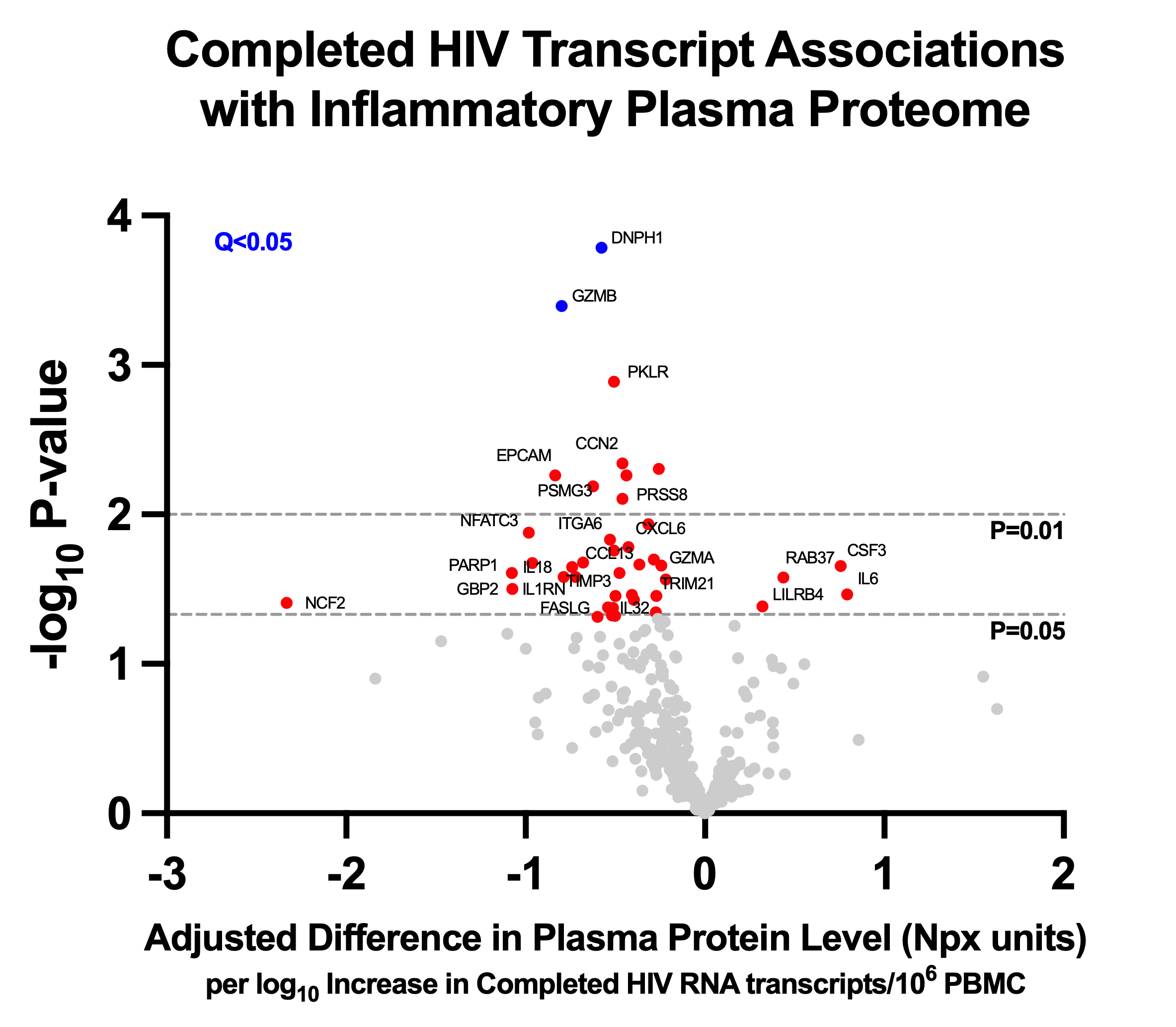
The 32 adults were suppressed on ART for a median 10 years; 11 (33%) were EFV-treated, 16% were women. A few plasma proteins were positively associated with levels of HIV RNA, including CSF3 (P<0.05 for 5’elongated, Pol, completed, and multiply spliced) and IL-6 (P<0.05 for completed HIV RNA). However, many more proteins were negatively associated with HIV RNA levels, and some persisted after FDR adjustment. DNPH1, GLOD4, ITGA6, PDGFB, PARP1, NCF2, PIK3AP1, and HCLS1 were negatively associated with 5’elongated HIV RNA, while DNPH1 and granzyme B (GZMB, linked to cytotoxic killing of infected cells) were negatively associated with completed HIV RNA (all Q<0.05). “Response to peptide” and “response to cytokine” were among the top biologic pathways associated with decreased levels of completed HIV RNA in gene ontology enrichment analysis (P<10-5). EFV use was also associated with lower levels of completed HIV RNA (P=0.023). EFV also appeared to modify the association between granzyme B levels and completed HIV RNA. Higher granzyme B was associated with lower completed HIV RNA in those on EFV-sparing ART (P<0.0001), but not among EFV users (P=0.73, P for interaction=0.09).
Conclusions
Immune sensing and clearance proteomic signatures are linked to lower levels of completed HIV transcripts in ART-suppressed PWH. EFV use is associated with lower completed HIV transcript levels and de-links the relationship between immune clearance pathways and completed HIV transcript abundance, consistent with its ability to promote HIV-infected cell death independent of adaptive immune sensing.
Table or Figure