Background
HIV-1 pathogenesis is driven by rapid depletion and infection of CD4⁺ helper T cells in lymphoid tissues during acute infection. The mechanisms underlying early CD4⁺ loss and the capacity of early antiretroviral therapy (ART) to preserve immune homeostasis and reverse pathology in these compartments remain incompletely defined. We hypothesized that acute HIV-1 infection with CXCR4- and CCR5-tropic clones in intact human tonsil explants would induce CD4⁺ T cell depletion and activate antiviral gene programs, while early ART initiation would act to protect against this loss and restore immune homeostasis.
Methods
Human tonsil resections from healthy donors (n=11) were dissected into 1×1 mm intact tissue blocks and cultured for 24 hours on surgical foam rafts at the air–liquid interface in complete RPMI media. Intact tonsil tissue blocks were then infected with CXCR4-tropic HIV-1 NL43-mCherry (10 ng p24), CCR5-tropic HIV-1 JRFL-GFP (100 ng p24), or uninfected. At 2- and 5-days post infection, combination ART cocktail with tenofovir (5 uM), emtricitabine (70 nM), raltegravir (20 nM) was administered with fresh media change and supernatant cells collected for flow cytometry of viability, infection, and immune cell markers. At 8-days post infection, tonsillar cells were collected for single-cell RNA sequencing 10X 3′ GEX platform.
Results
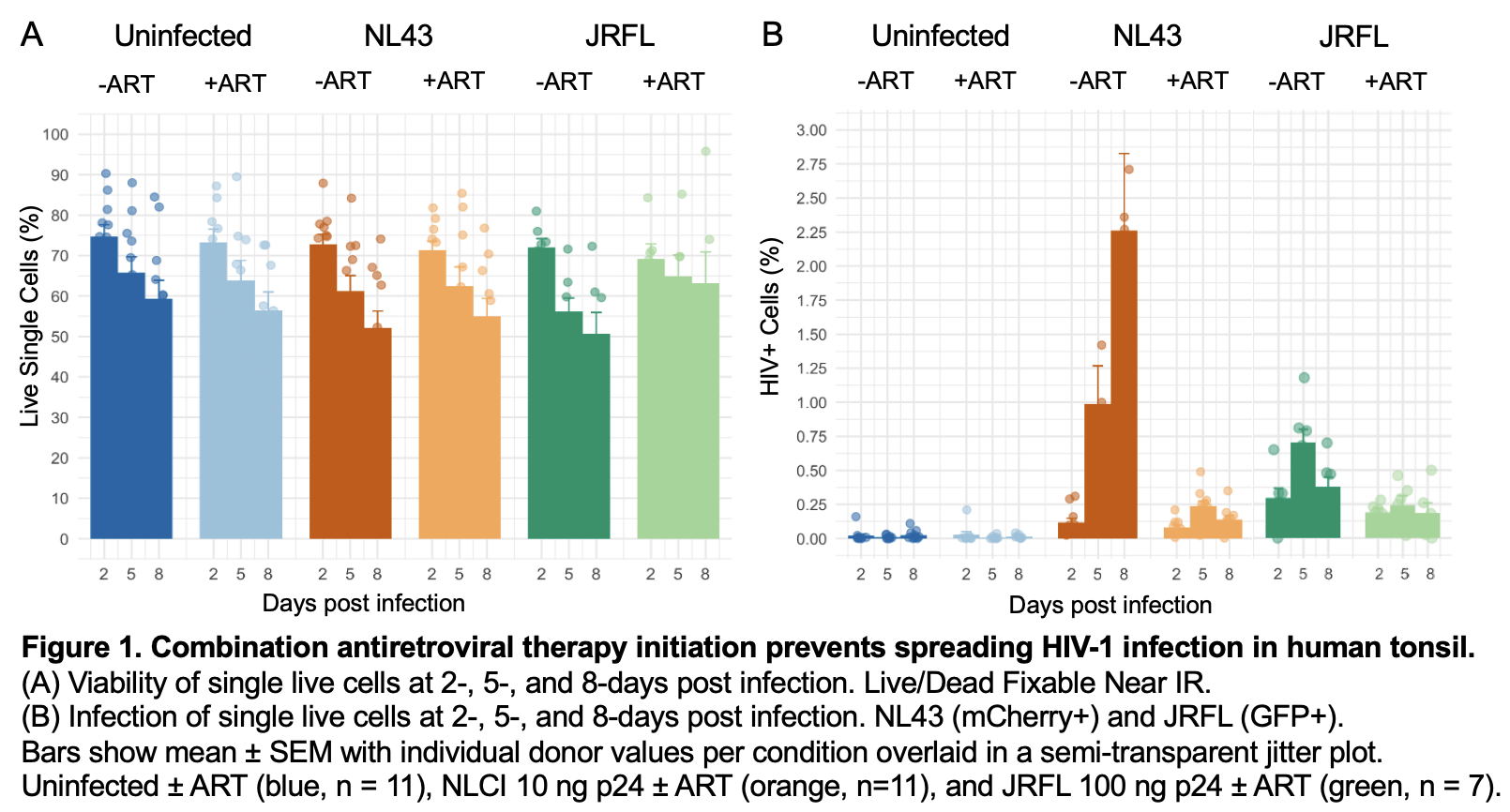
Peak infection occurred in NL43-infected cells at day 8 (mean 2.26±0.56%, n=11) and JRFL-infected cells at day 5 (mean 0.77±0.22%, n=7). Early ART limited viral spread, reducing infection at day 8 in NL43 (0.15±0.03%) and JRFL (0.34±0.14%) conditions. Gene set enrichment analysis of infected T cells reveals robust activation of type I interferon response and suppression of selenocysteine metabolism involved in antioxidant defense. In contrast, infected ART-treated T cells reduce interferon signaling and instead activate the complement cascade and immunoregulatory interactions between lymphoid and non-lymphoid cells.
Conclusions
This study demonstrates that ex vivo human tonsil tissue can model the dynamics of acute HIV-1 infection and early ART response, capturing both viral replication and host immune reprogramming at single-cell resolution. The findings suggest that while early ART initiation suppresses viral spread, it does not fully prevent lymphoid reservoir establishment. These insights will aid further dissection of host–virus interactions in lymphoid compartments and inform the development of interventions aimed at achieving durable HIV remission.
Table or Figure