Background
Population-based data characterizing temporal trends in HIV prevalence and incidence among key populations are critical to monitoring progress towards epidemic control, but such data are sparse. We examined overall and age-specific trends in HIV incidence and prevalence among men who have sex with men (MSM) and people who inject drugs (PWID) in India.
Methods
We conducted three cross-sectional surveys of MSM (3 cities) and PWID (6 cities) in India in 2012-13, 2016-17 and 2023-24 (n~750-1000 per city per survey). Participants were recruited via respondent driven sampling (RDS) and received rapid HIV testing and tests for CD4 count, HIV RNA, and HIV recency biomarkers (e.g., LAg avidity). We estimated HIV incidence using recent infection testing algorithms and assessed HIV prevalence and viral suppression (<150 c/mL) among participants with HIV, both overall and by stratified by age. Prevalence estimates were RDS-II weighted; temporal changes (2012-13 vs. 2023-24) were assessed via age and site-adjusted Poisson regression with robust variance.
Results
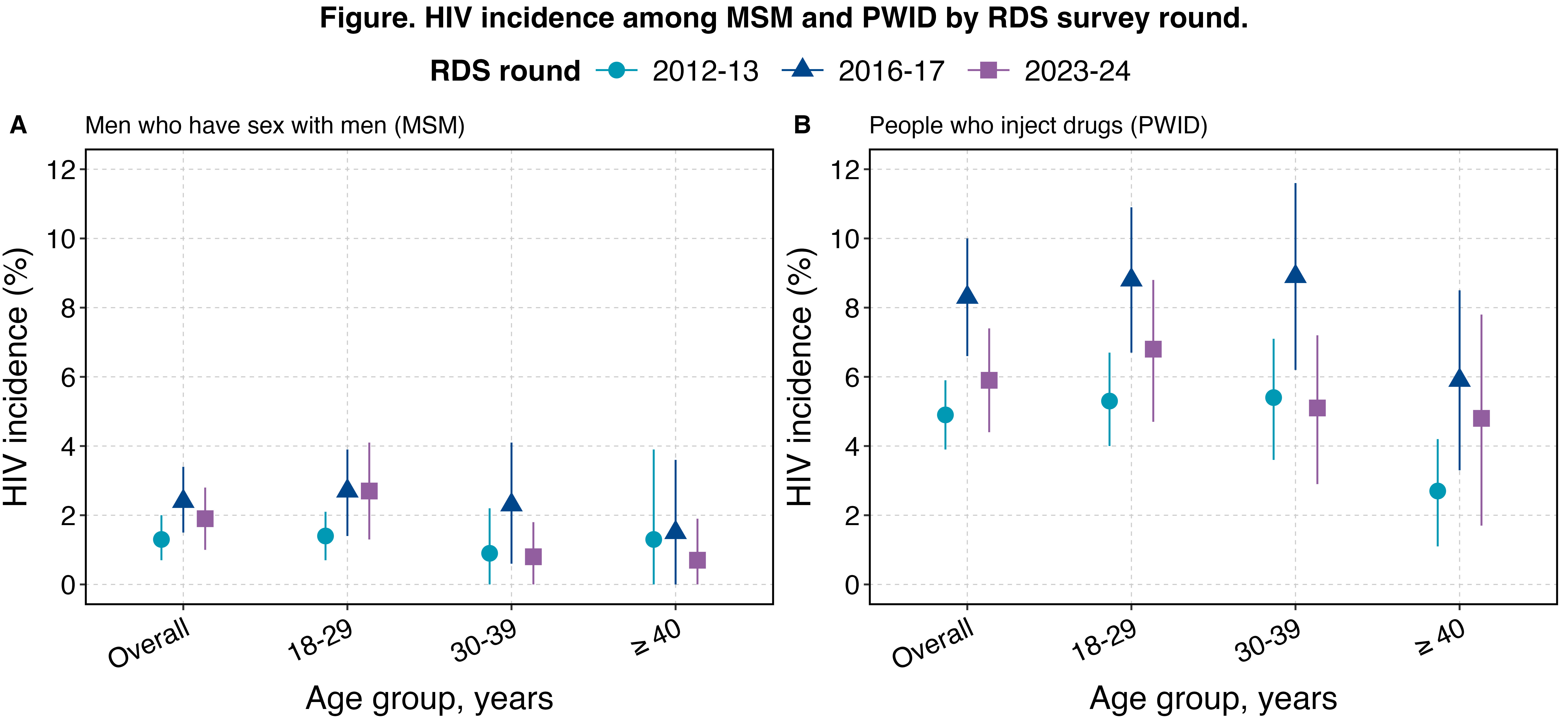
Across three survey rounds, we recruited in total 8,242 MSM (median age: 25 [IQR=21-32]) and 16,496 PWID (median age=29 [IQR=24-36]; 96% male). HIV incidence remained persistently high between 2012-13 and 2023-24 among MSM (1.3% vs. 1.9%; p=0.349) and PWID (4.9% vs. 5.9%; p=0.247) overall and within each age group (Figure). HIV prevalence more than doubled from 7% in 2012-13 to 20% in 2023-24 (aPR=2.0; 95%CI=1.6-2.5) among MSM and from 19% to 40% (aPR=2.0; 95%CI=1.8-2.2]) among PWID, with increases across all ages, including from 6% to 16% (aPR=2.2; 95%CI=1.6-3.1) among MSM aged 18-29 years and from 15% to 37% (aPR=2.1; 95%CI=1.8-2.4) among PWID aged 18-29 years. Viral suppression increased overall from 21% to 76% (aPR=3.2; 95%CI=2.3-4.6) among MSM with HIV and from 16% to 32% (aPR=2.2; 95%CI=1.8-2.7) among PWID with HIV and across all ages. However, the 18-29-year age group consistently had the lowest suppression levels (e.g., 21% of PWID 18-29 years vs. 68% of PWID >40 years in 2023-24).
Conclusions
The persistently high HIV incidence, rising HIV prevalence, and suboptimal viral suppression particularly among young key populations signal a need to intensify, not retreat from, targeted intervention scale-up. Sustained commitment to the implementation of effective HIV prevention strategies, including pre-exposure prophylaxis, for these groups will be key to achieving global HIV epidemic control.
Table or Figure