Background
In January 2025, U.S. foreign aid, including the President’s Emergency Plan for AIDS Relief (PEPFAR), was disrupted. While modeling studies have projected population-health consequences, no population-representative studies have quantified disruptions in HIV service-delivery functions. These activities (e.g., patient tracing) and stable procurement of commodities have driven success in the HIV response to date; understanding disruptions to such activities is critical to coordinating an effective response.
Methods
We selected a random sample of all public HIV care facilities in KwaZulu-Natal (KZN), South Africa, with selection probability proportional to facility size. Sampling was stratified by rurality and district. Structured surveys were conducted with clinic managers to document interruptions to staffing, service provision, and perceived patient effects. We generated formally representative weighted estimates of the prevalence of interruptions at the facility level and the number of patients affected using weights inverse probability of facility selection.
Results
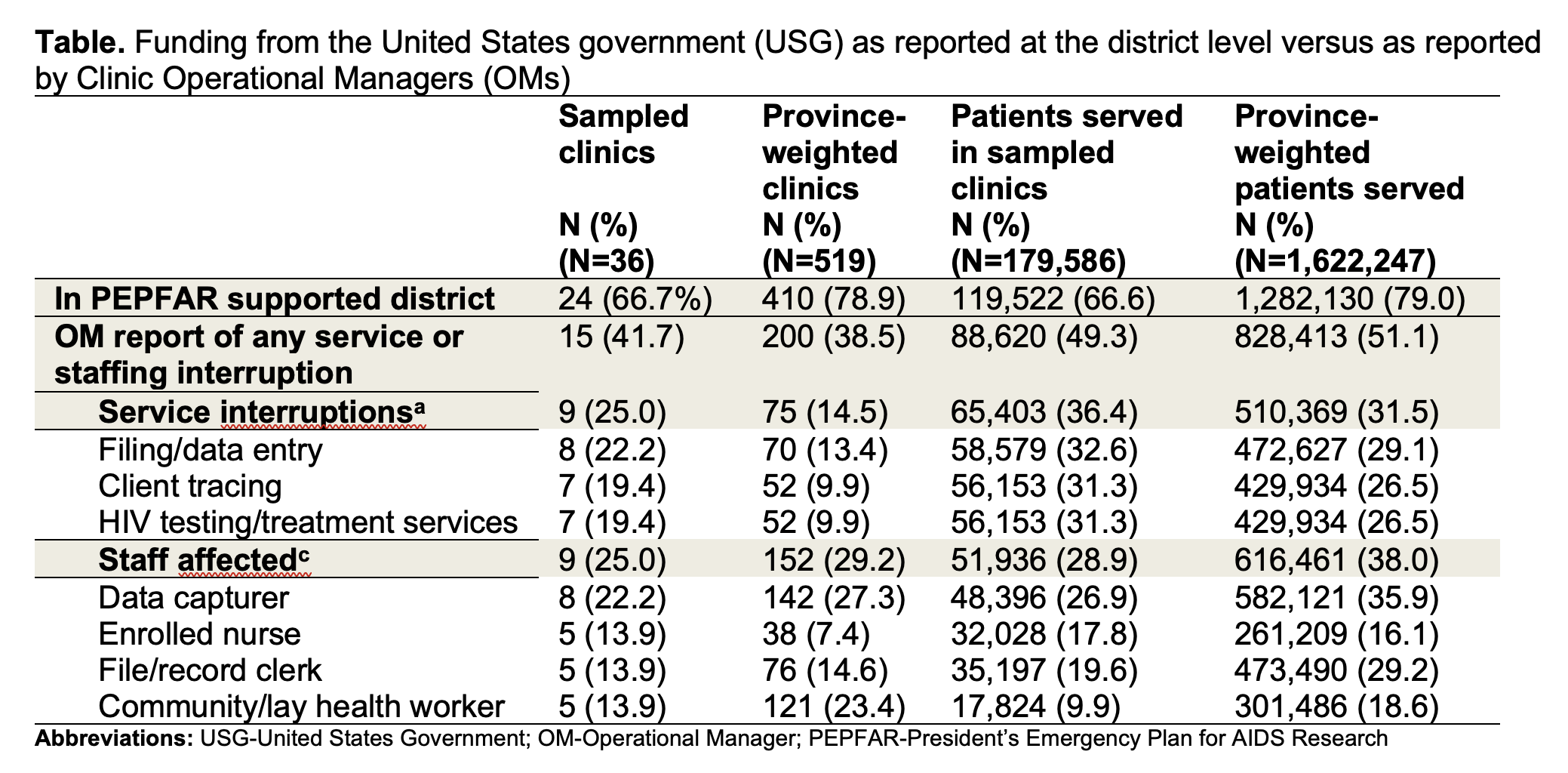
Thirty-six of 519 facilities in KZN (6.9%) were sampled. A total of 179,586 patients with HIV (PWH) were seen across sampled clinics (median: 637 patients/clinic; interquartile range: 330, 1520), representing 1,622,247 patients. Twenty-one clinics representing 52.8% clinics in KZN reported receipt of PEPFAR support prior to January 2025. Fifteen clinics serving 88,620 PWH reported staffing or service interruptions. Weighted estimates found the most common service interruption was in data entry/filing with 13.4% of clinics serving 472,627 PWH. Interruptions to client tracing and HIV testing/treatment services were also reported in 9.9% of clinics serving 429,934 PWH. Weighted estimates demonstrate 29.2% of clinics experienced staffing disruptions with data capturers, community health workers, and file/record clerks most impacted (Table). Weighted estimates show increases in patient wait times occurred in 11.0% of clinics serving 467,676 clients and concerns about patient retention in 8.8% of clinics serving 387,651 PWH.
Conclusions
Instability in global HIV funding has effects beyond treatment supply and undermines a range of essential functions crucial to treatment success. Policies that destabilize frontline staff and “invisible” services weaken the resilience of HIV programs. The public health response to aid disruptions must not lose sight of the breadth of services that make the HIV response successful.
Table or Figure