Background
Chlamydia trachomatis (CT) and Neisseria gonorrhoeae (NG) infections can cause adverse health outcomes and facilitate HIV transmission. CT/NG rates in sub-Saharan Africa are increasing, with Kenya among the countries with the highest burden of HIV. However, recently estimated Kenyan CT/NG rates are limited or biased.
Methods
Between 12/2021 and 4/2023, we enrolled participants in Kericho and Homa Bay, Kenya, aged 15–55 years without HIV, and who reported a recent STI, injection drug use, transactional sex, condomless sex, or anal sex with male partners. Anorectal swabs, oropharyngeal swabs, and urine were tested using the PCR-based Xpert® CT/NG (Cepheid) every 12-24 weeks for up to 72 weeks. Participants completed behavioral questionnaires every 24 weeks with responses carried forward to visits without a questionnaire. CT/NG treatment followed national guidelines. Reinfections were counted ≥30 days after treatment completion or after an interim negative test. Negative binomial and Poisson regression were used to estimate overall and anatomic site-specific event rates and 95% confidence intervals (CIs).
Results
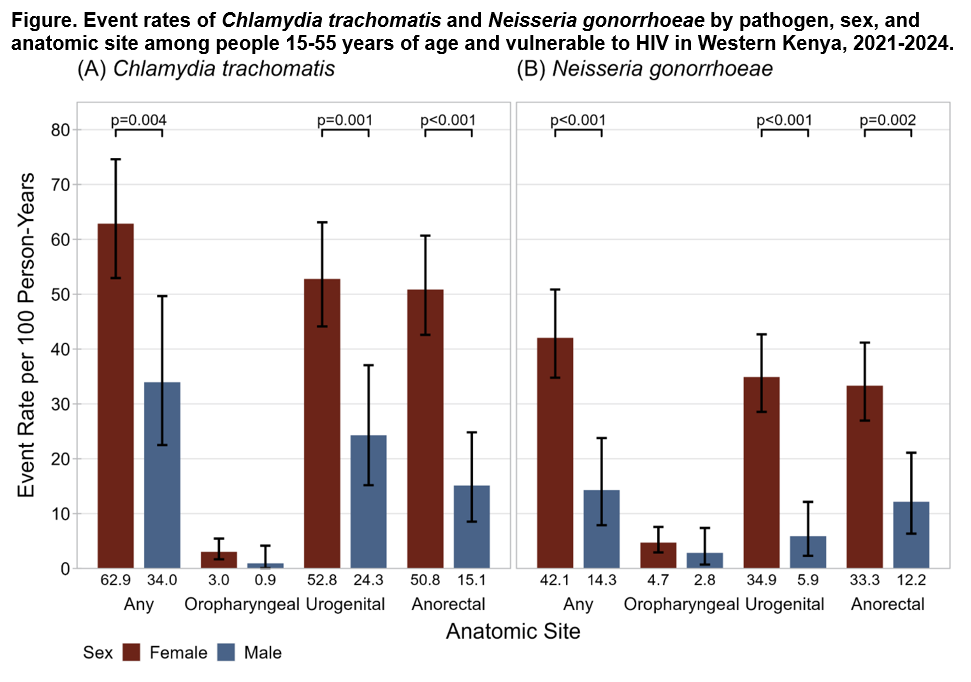
Of 407 participants, 325 (79.9%) were female, the median age was 22 years (interquartile range 19-24), 319 (80.8%) reported sex work, and 43/82 males (52.4%) were men who have sex with men. CT and NG event rates were 56.3/100 person-years (PY; 95%CI 47.7-66.2) and 35.8/100PY (95%CI 29.6-43.1), respectively. 154/366 (42.1%) participants with >0 follow-up time for CT had at least one CT infection, including 40 with two and 6 with three CT infections; 117/372 (31.5%) participants had at least one NG infection, including 18 with two and 3 with three NG infections. CT and NG rates were two- to three-fold higher among females, with urogenital NG rates six-fold higher among females (Figure). Of 167 anorectal CT and 116 anorectal NG infections, recent receptive anal sex was reported in only 14 (8.4%) and 12 (10.3%) cases, respectively. While concurrent infection across multiple sites was observed, 42.5% of CT and 32.4% of NG occurred solely at the anorectal or urogenital site. CT/NG co-infection was uncommon; a single organism was detected in 93.6% of anorectal and 88.8% of urogenital infections.
Conclusions
Our findings support a strategy of comprehensive, PCR-based screening for anorectal and urogenital CT/NG in vulnerable populations of both sexes, regardless of self-reported sexual behaviors. Universal screening for oropharyngeal CT/NG is not supported by our data.
Table or Figure