Background
The HIV-associated neurocognitive disorder (HAND) framework relies on fixed thresholds, domain-level averaging, and subjective report of everyday functioning, which may obscure meaningful variation and subtle decline. In contrast, Latent Profile Analysis (LPA) and Growth Mixture Modeling (GMM) offer empirical alternatives to characterize cognitive profiles (CP) and functional trajectories (FT). Together, these methods can illuminate how patterns of cognitive performance related to functional change.
Methods
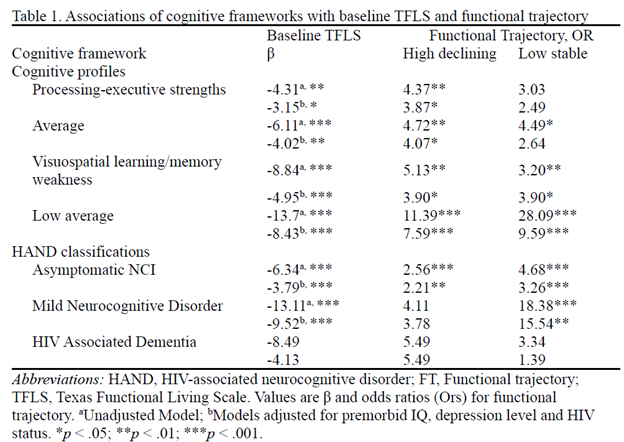
Data were obtained from 476 adults (358 people with HIV [PWH], 118 demographically similar without HIV). LPA was applied to 14 demographically adjusted neuropsychological (NP) T-scores at baseline, yielding five CP. GMM identified three FT using Texas Functional Living Scale (TFLS) T-scores among those with ≥ two timepoints (N=280 at Time 2; N=187 at Time 3): High/Declining, Moderate/Improving, and Low/Stable. HAND classification followed Frascati criteria. Linear and multinomial regression models examined associations between HAND, CP and both baseline TFLS and FT outcomes, with and without adjustments for premorbid IQ (PIQ; Wechsler Test of Adult Reading), depression (Beck Depression Inventory) and HIV status.
Results
Select results shown in Table 1. In univariate models, both CP and HAND classes were associated with TFLS and odds of functional decline. However, in adjusted models, CP associations remained robust, particularly in CPs characterized by visuospatial weakness and overall low performance. In contrast, most HAND associations weakened after adjustment. Higher PIQ was linked to better TFLS (β= 0.34, p < .001) and lower odds of decline (OR = 0.96, p < .001). Moderate depression was independently associated with lower TFLS (β= -5.78, p = .008) and Low/Stable FT (OR = 3.75, p = .005). HIV status and severe depression were not significant.
Conclusions
Compared to HAND, CP and FT classes derived via mixture modeling more consistently captured individual variation in both baseline and longitudinal functioning. These results underscore the utility of empirical classification for identifying cognitive and functional subtypes at risk for decline, supporting individualized approaches to neuro-HIV care.
Table or Figure