Background
HIV/SIV infection upregulates immunoregulatory factors, including PD-1 and IL-10, which impair antiviral responses and promote viral persistence. Blocking these pathways represents a promising approach to enhance viral control after ART treatment interruption (ATI). Dual IL-10/PD-1 blockade has been shown to limit viral replication post-ATI in SIVmac239-infected rhesus macaques (RMs). Still, it failed to reduce the reservoir, and the numerous doses of anti-IL-10 caused adverse events. Here, we assessed whether two cycles of IL-10/PD-1 blockade across two rounds of ATI, with fewer aIL-10 doses, improve viral control and reduce the SIV reservoir, while limiting treatment burden.
Methods
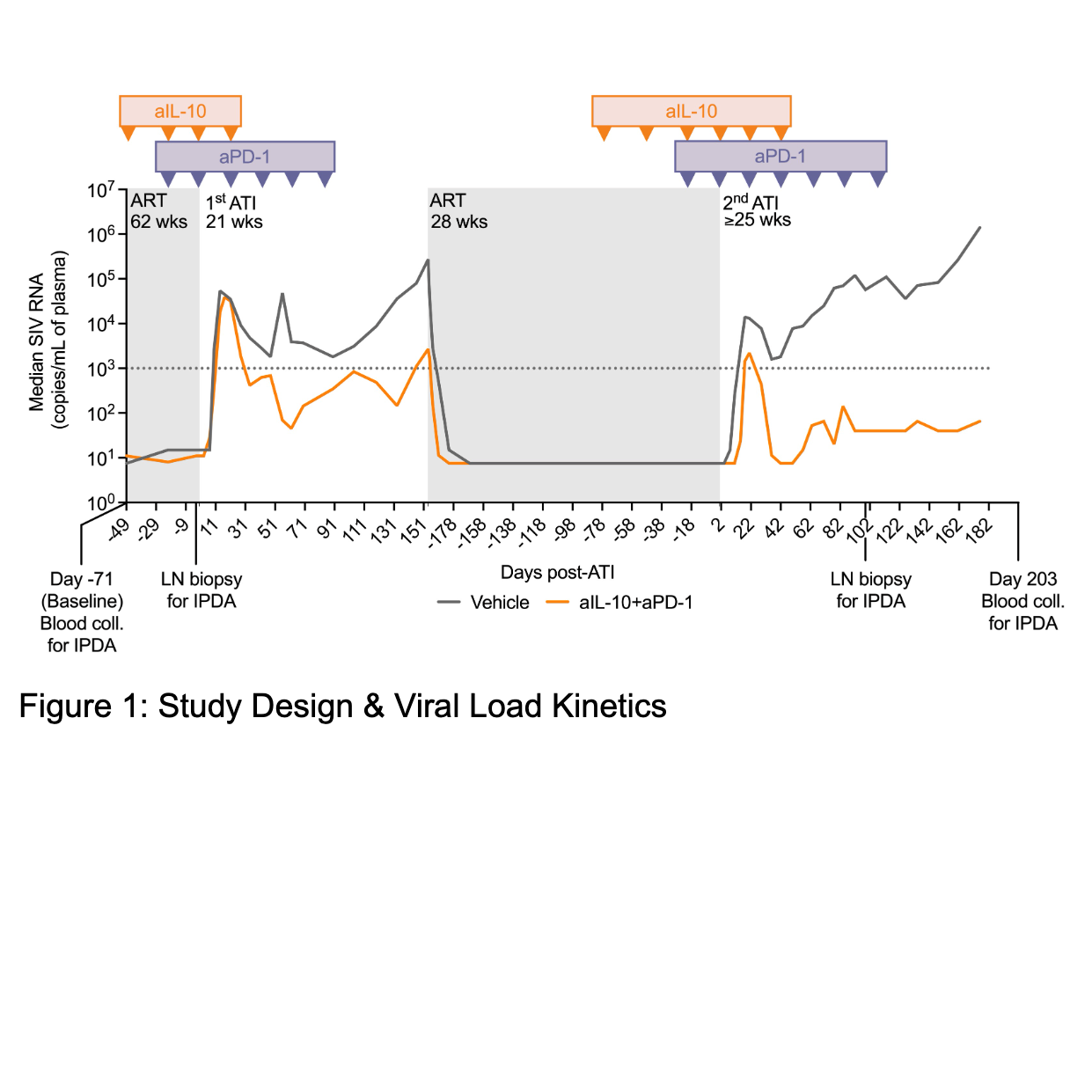
17 RMs infected with barcoded SIVmac239m initiated ART on Day 42 post-infection and remained on ART for 55 weeks before starting two cycles of aIL-10+aPD-1 (10mg/kg; n=8), or vehicle (n=9), each leading to an ATI (Fig.1). RMs were monitored up to Day 203 after the 2nd ATI. Blood and lymph node (LN) biopsies were collected to evaluate viral load (VL), intact SIV reservoir, and viral barcode distribution.
Results
RMs treated with aIL-10+aPD-1 showed a stronger viral control during the 1st ATI, with 52% of the VL measurements <103 copies/mL, compared to 16% for the vehicle group. This control resulted in a 1.82 log lower VL at ART reinitiation in the treated RMs compared to vehicles. At the 2nd ATI, the aIL-10+aPD-1 RMs showed an even stronger viral control, with a peak VL 0.82 log lower than that of the vehicles, and 83% of the VL measurements <103 copies/mL, compared to 34% for the vehicles. This viral control persisted for >175 days post-ATI. Remarkably, the aIL-10+aPD-1 therapy also reduced the intact SIV reservoir in CD4 T cells from the blood and LN in 100% of treated RMs, with a median decline of 0.83 log in blood CD4 T cells between baseline (1st phase) and necropsy/D203 post-ATI (2nd phase) and of 0.79 log between Day -2 post-ATI (1st phase) and Day 98 post-ATI (2nd phase) in the LN. In the vehicle RMs, an increase of 0.90 and 0.32 log is observed in the blood and the LN for these same time points, resulting in the dual-treated RMs having 1.85 and 0.80 log lower reservoirs in blood and LN, respectively, than vehicle RMs at the latest time point.
Conclusions
Two cycles of IL-10/PD-1 blockade promote a durable SIV control without ART for >175 days and potently reduce the intact reservoir in blood and LN. This represents the 1st immune-based strategy to reduce SIV persistence in RMs substantially.
Table or Figure