Background
While ablative and excisional methods aim to remove cervical intraepithelial neoplasia (CIN) in women living with HIV (WLH), its effects on long-term clearance of HPV infection is unclear. HPV persistence remains a key driver of CIN recurrence, yet post-treatment HPV dynamics are poorly characterized. Understanding these dynamics is essential if HPV detection is to be used as a marker of treatment success.
Methods
WLH in Kenya with CIN2+ (n=400) were randomized between cryotherapy and loop electrosurgical excision procedure (LEEP) and followed for 2 years (2011–2016), then re-enrolled 10 years later (2023–2024). In addition to HPV genotyping at baseline, participants underwent Pap smear and HPV genotyping at 6-monthly intervals in the first 2 years and at 10 years; abnormal cytology was confirmed by colposcopy-directed biopsy. In an HPV pattern analysis of the first 2 years, HPV detected at baseline was defined as “prevalent” and those detected after treatment was defined as “incident”; patterns were then further categorized as “persistent” if there were ≥2 type-specific consecutive detections. Type-specific patterns were compared to HPV genotypes detected at 10-year follow-up and CIN2+ recurrence.
Results
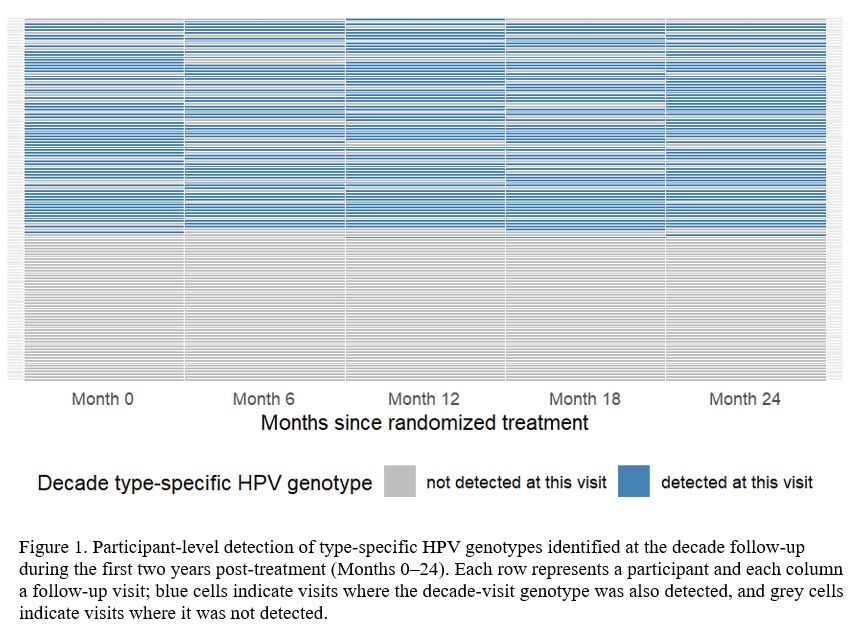
Of 400 women, 247 (61.8%) were re-enrolled 10 years post-randomization and had a mean age of 48 years and an average of 13 years on antiretroviral therapy. The prevalence of HPV at 10 years was 53.8% (133/247), with no difference between treatment arms (LEEP 53.8% vs. cryotherapy 53.9%, p >0.9). Among 241 type-specific detections, 67.6% were high-risk, most commonly HPV16 (16.0%), HPV52 (14.3%), and HPV58 (11.3%). A decade later: 99 (41.1%) of the genotypes detected had been observed within the first 2 years of follow-up (Figure 1), of which 59.6% represented “prevalent persistent” detections and 19.2% “incident persistent”; 32 (13.0%) participants had abnormal Pap smears; and 21 (8.5%) had CIN (CIN1: 42.9%; CIN2+: 57.1%). WLH with HPV detected at 10 years had more frequent nadir CD4 <200 (63.3% vs 36.7%, p=0.4) and CIN2+ recurrence (7.5% vs 1.8%, p=0.6) than those without detection.
Conclusions
A decade after treatment with cryotherapy and LEEP, HPV detection remained high among WLH, and type-specific persistence was common with nearly half traceable to the first two years. These findings highlight the need for guidelines to address the impact of underlying HPV infection in WLH and to help patients and clinicians understand the source and significance of post-treatment HPV detection.
Table or Figure