Background
Successful implementation of perinatal HIV prevention programs has greatly decreased the rate of vertical transmission. Most infants perinatally HIV-exposed are uninfected (HEU). Many health complications have been reported in HEU compared to HIV-unexposed (HUU) infants, including immune dysregulation and increased risk of infection, particularly before 12 months of age. Increased inflammation resulting from in utero exposure to maternal HIV is a proposed mechanism of HEU immune dysregulation. This study compared markers of inflammation and immune activation over the first year of life between HEU and HUU infants.
Methods
Stored plasma samples were sourced from HEU infants enrolled in the International Maternal Pediatric Adolescent AIDS Clinical Trials (IMPAACT) protocol P1025, a prospective observational study that enrolled US women with HIV and their infants between 2002-2013, and from 3 studies that enrolled healthy HUU infants in Aurora, CO. We used the MesoScale Discovery platform to measure 16 markers of inflammation and immune activation at weeks 2, 6, 16, 24 and 48 of life.
Results
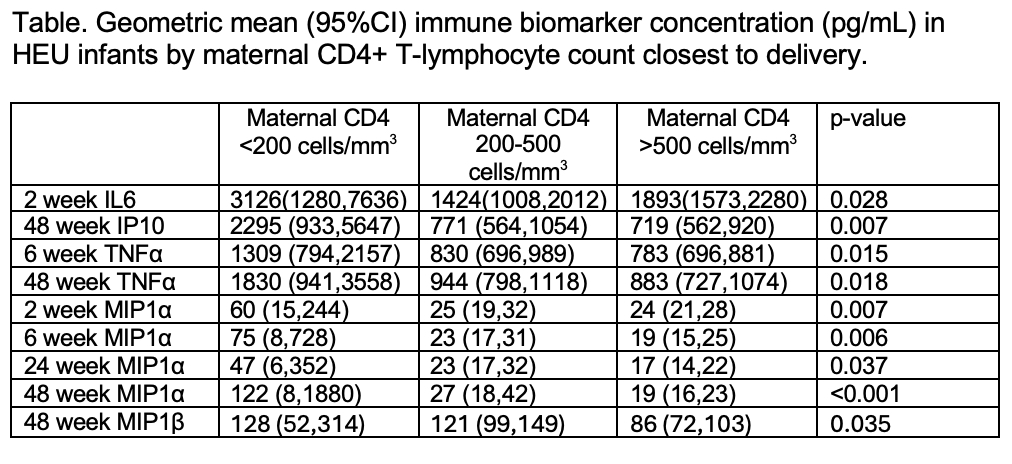
In a multivariable regression analysis of 135 HEU and 51 HUU infants that adjusted for sex, race/ethnicity, delivery mechanism, gestational age and birth weight, we identified multiple differences in concentrations of inflammatory and immune biomarkers between HEU and HUU infants, including: IL17A, IL1β, IL4, TNFα, IL5, IL8, MCP1, MDC, MIP1α and MIP1β. In all cases, the concentrations of biomarkers were higher in HUU than HEU. Among HEU infants, lower maternal CD4+ T-lymphocyte count close to delivery was associated with higher infant concentrations of IL6, IP10, TNFα, MIP1α, and MIP1β (Table) and viral load ≥400 RNA copies/ml was associated with higher infant IL2 and IL10.
Conclusions
We identified multiple differences in markers of inflammation and immune activation between HEU and HUU infants in the first year of life. HEU infants tended to have lower biomarker concentrations compared to HUU, which may be a result of immune dysfunction or exhaustion. Lower maternal CD4+ T-lymphocyte count and higher HIV viral load at delivery were associated with higher concentrations of several infant inflammatory biomarkers, suggesting an association between advanced/uncontrolled maternal HIV and increased infant inflammation that may persist through the first year of life. Further studies are needed to determine the mechanisms through which in utero exposure to maternal HIV affect infant immune development.
Table or Figure