Background
Individuals living with HIV require antiretroviral therapy (ART) to suppress viral replication. When therapy is stopped, most experience virologic rebound, but the interval between cessation and rebound varies widely, and the events preceding rebound are poorly understood. We examined how levels of polyadenylated (poly-A) HIV transcripts change during analytic treatment interruption (ATI), hypothesizing that transcript levels would rise as rebound approached.
Methods
We analyzed five individuals harboring subtype B HIV-1 who previously enrolled in broadly neutralizing antibody (bnAb) trials. Four received 3BNC117 during ART before ATI; time-to-rebound was 3–6 weeks (ID 601, 602, 609 and 614). One received 3BNC117 + 10-1074 after ATI and rebounded at week 15 (ID 9201). Peripheral blood mononuclear cells were collected at screening and longitudinally until rebound. Poly-A transcripts were isolated and quantified by droplet digital PCR for unspliced (LTRgag), 3’UTR-containing, and total poly-A species. Viral reservoir size at study enrollment prior to bnAb treatment was measured via Intact Proviral DNA Assay (IPDA).
Results
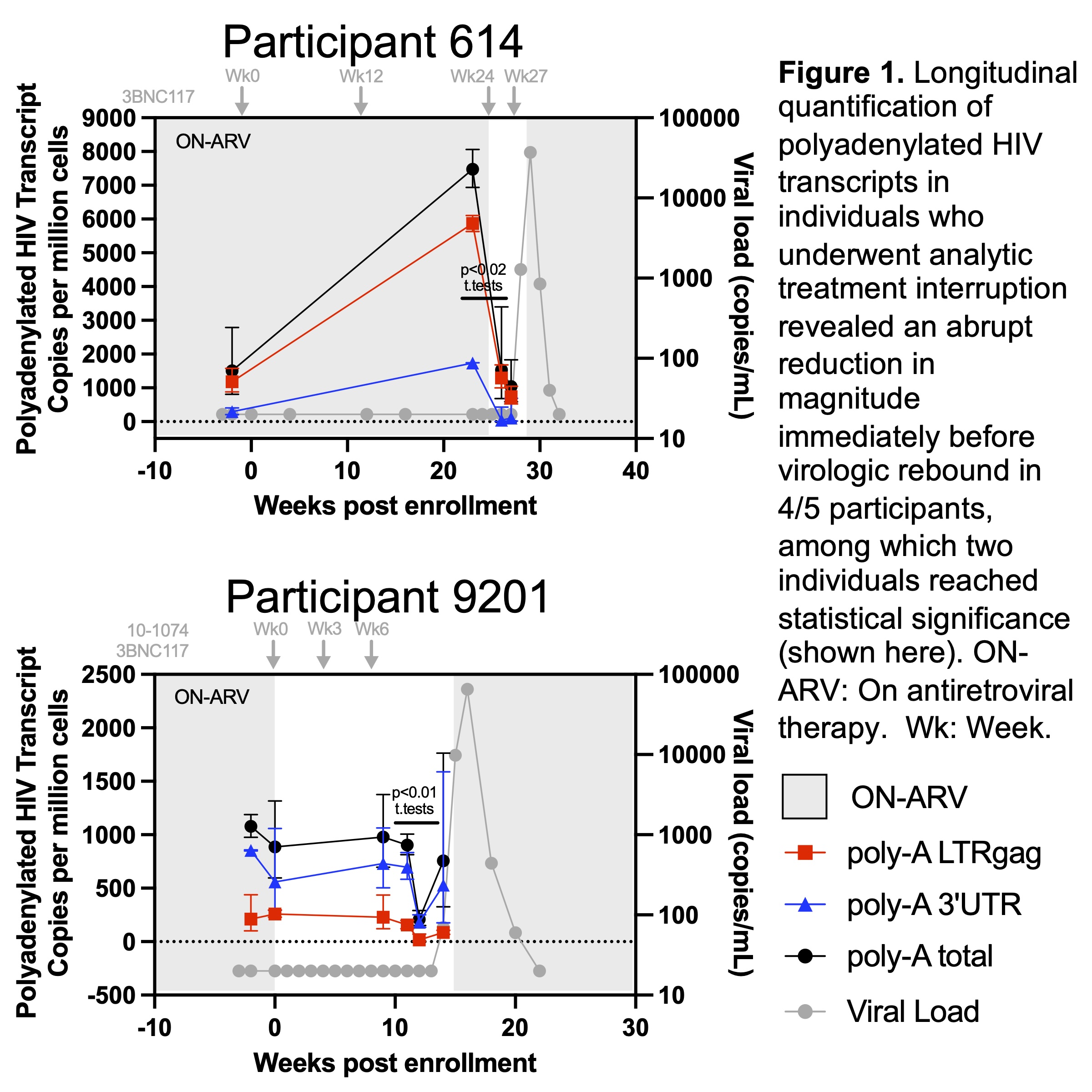
All participants had detectable poly-A transcripts throughout follow-up. Copy numbers per million CD4+ cells varied markedly across individuals (unspliced 46-1968; 3’UTR 162-1403; total 232-2877) and correlates strongly/moderately with 3’ and 5’ IPDA reservoir size measurements respectively (Spearman r=0.7-0.9 and 0.6-0.7). The fraction of unspliced transcripts within the total pool ranged from 20–79%. Longitudinal trajectories were heterogeneous: one participant (ID 601) showed a slight, non-significant upward trend, whereas four (IDs 602, 609, 614, 9201) exhibited abrupt declines in HIV transcript levels immediately before rebound. While changes in ID 602 and 609 did not reach statistical significance, in the other two participants (IDs 614 and 9201), poly-A transcript levels dropped 4–8-fold, both at about 2 weeks before rebound (t-tests all p<0.02 and all p<0.01, Figure 1).
Conclusions
Poly-A transcripts, essential for viral protein production and rebound, displayed unexpected decreases in most individuals prior to rebound, contrary to our initial hypothesis of gradual increase. These findings suggest dynamic regulation and possible transient immune control immediately before viremia. Larger studies should investigate mechanisms of transcript suppression and its relationship to immune responses during ATI.
Table or Figure