Background
HIV-1 continues to impose unequal burdens in US communities. Incidence rates remain elevated among Black and Hispanic men who have sex with men (MSM), transgender women (TGW), and cisgender women (CGW) with PrEP indications. Insurance barriers, e.g. prior authorization and coverage restrictions, hinder PrEP access and often lead to PrEP abandonment in these underserved populations. Tao et al. (2023) found that rejected insurance claims for PrEP were linked to an approximately 2-fold higher risk of HIV-1 acquisition. Consequently, decreased PrEP initiation increases HIV-1 treatment costs and productivity losses over time. We evaluated the clinical and economic returns of removing insurance barriers to PrEP access for the above populations.
Methods
Using a lifetime-horizon HIV-1 microsimulation model, we projected the impact of removing insurance barriers for high-incidence populations. From payer, healthcare ecosystem, and societal perspectives, we compared the scenario of current insurance barriers (comparator) with that of removal of all insurance barriers (intervention). Return on investment (ROI) was calculated as HIV-related costs averted per additional dollar spent on PrEP, with ROI >1 indicating net savings. Model inputs included HIV-1 incidence and progression, PrEP-use patterns, treatment and PrEP costs, and insurance barrier data estimated from published and unpublished sources.
Results
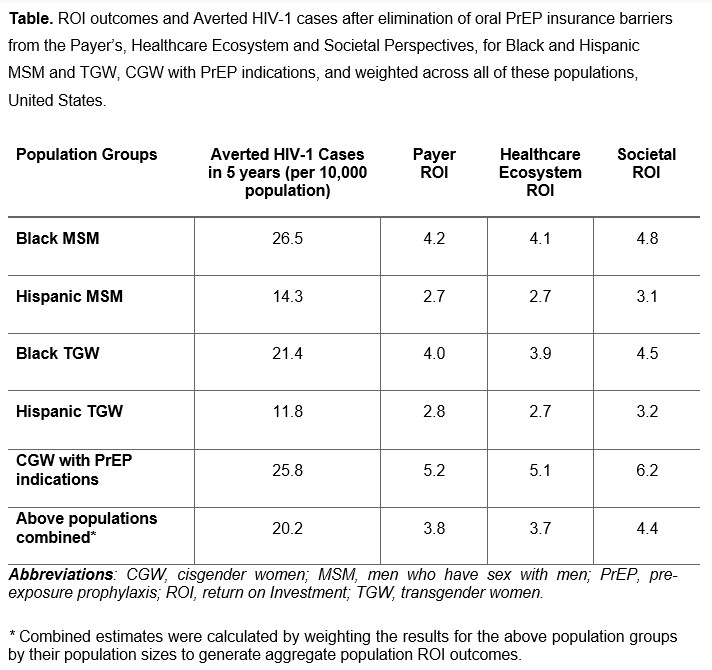
Removing insurance barriers raised PrEP use and spending, averted HIV-1 cases, and reduced downstream treatment costs and productivity losses. The intervention averted an estimated 20.2 new cases per 10,000 people over 5 years for the populations combined. For every additional dollar spent on PrEP, $3.8 were returned for payers, $3.7 for the health ecosystem, and $4.4 from the societal perspective. ROI ranged from $2.7–$5.2 (payers), $2.7–$5.1 (healthcare ecosystem), and $3.1–$6.2 (societal) across populations (Table).
Conclusions
Removing PrEP insurance barriers for populations with high HIV-1 incidence would avert new HIV-1 cases and lower downstream treatment costs, yielding net economic savings. These findings underscore the importance of adhering to USPSTF guidelines to reduce insurance barriers to PrEP access. Expanding PrEP access to populations who are disproportionately affected by HIV contributes to meeting Ending the HIV Epidemic goals, and offers fiscal and productivity benefits for US payers, healthcare ecosystem, and society.
Table or Figure