Background
PWH have increased risk of cancer and worse cancer outcomes compared to people without HIV. Some research suggests that certain cancer treatments result in CD4 decline, increasing risk of infection or loss of viral control. However, analysis of specific treatments, cancers, or other factors that may influence immunologic outcomes in PWH receiving cancer treatment has been limited. We aimed to characterize the effect of cancer treatment on CD4 count and HIV viral load (VL) in PWH.
Methods
This study was approved by the Yale University IRB. We collected demographic (age, sex, race/ethnicity), HIV (CD4, CD8, VL values), and oncology data (primary tumor site, stage, treatment) on PWH diagnosed with cancer between 2016-2022. We defined baseline CD4 as the most recent value prior to treatment initiation, and loss of viral control as sustained VL <200 copies/mL two years before cancer diagnosis followed by any VL >200 copies/mL within two years of treatment initiation. A mixed-effects model was used to estimate post-treatment change in CD4 count and time to 80% recovery of baseline CD4.
Results
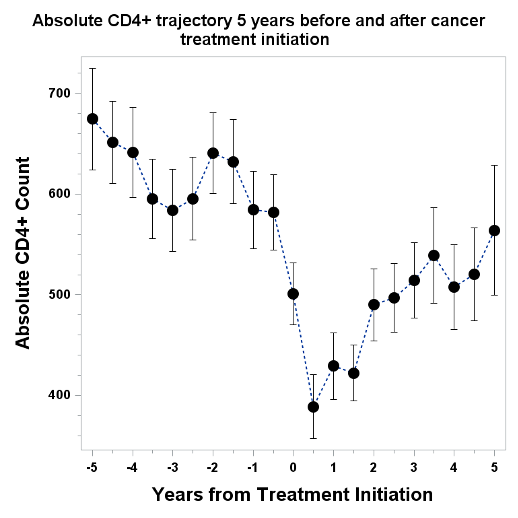
We identified 283 patients (median age 60, 67% male) for analysis. The most common cancers were lung (n=41), non-Hodgkin lymphoma (n=33), and prostate (n=30). We found 89% of patients had baseline viral load <400 copies/mL. Mean baseline CD4 was 501 (95% CI 441, 562). Figure 1 presents the mean CD4 trajectory ±5 years from cancer treatment initiation. From baseline to one year, the overall slope was -94 cells/mL (SE 24, P<0.001). Head and neck cancer exhibited a steeper CD4 decline than other cancer types [-164 cells/mL (SE 61, P=0.0075)]. Patients treated with radiation therapy (RT) experienced greater CD4 decline than patients not treated with RT [-183 cells/mL (SE 40, P<0.001)]. By 6 months, 50% of patients had recovered to 80% of their baseline CD4 [median 184 (134, 230) days], but by 2.5 years, the percent of patients with 80% CD4 recovery had only increased to 68%. No patients that were initially virally suppressed lost viral control after cancer diagnosis.
Conclusions
This study demonstrates that PWH exhibit significant decreases in CD4 count upon cancer treatment initiation which may be sustained for years, particularly those with head and neck cancer and/or treated with radiation. Future research with a larger observational dataset will allow for evaluation of predictors of CD4 recovery with cancer treatment using multivariate analysis.
Table or Figure