Background
Elite Controllers (ECs) spontaneously maintain undetectable viral loads without antiretroviral therapy. Both viral and host genetic factors, including specific MHC alleles, contribute to control by promoting HIV-specific CD8⁺ T-cell responses. Virus-induced innate immunity can establish a sustained “trained” state that protects against heterologous infections. However, the contribution of innate and trained immunity to the development of durable adaptive responses to HIV remains unclear.
Methods
Integrated unbiased analysis of single cell multi-omics, cytokine and metabolome quantitative monitoring was performed in plasma and PBMCs from a cohort of 13 untreated ECs, 10 viremic non-controllers (VNCs), and 20 people without HIV (PWoH). Transcriptional signatures were mapped onto hematopoietic stem and progenitor cells (HSPC) using in-silico deconvolution. Pseudotime analysis reconstructed HSPC differentiation trajectories. Cytokine profiles were validated in an independent EC cohort (n = 14).
Results
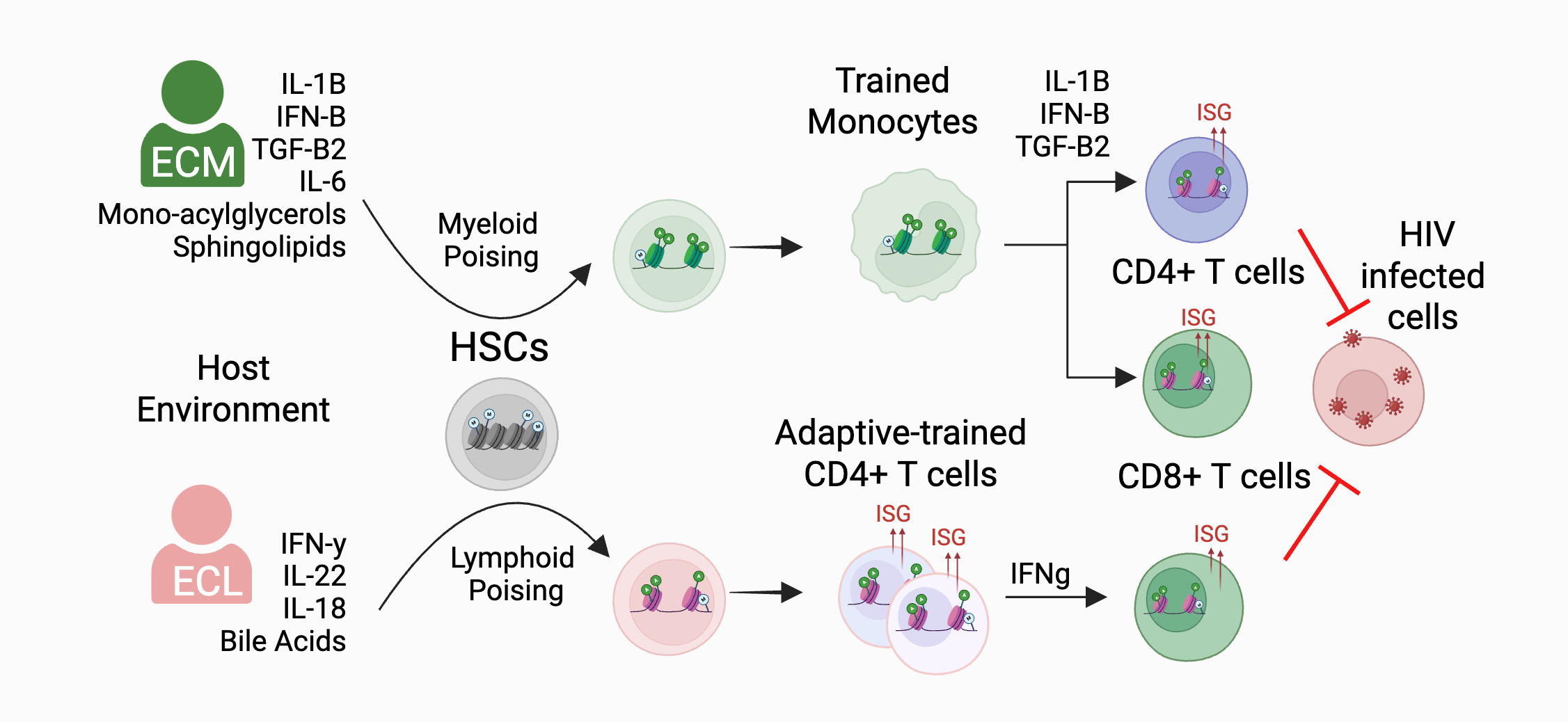
Transcriptional profiling revealed two clusters for ECs. One with myeloid signatures and upregulated expression of genes of trained innate immunity and inflammasome activation (ECM). The other exhibited lymphoid-biased transcriptional profiles, upregulation of Il-7/IL-15 Jak/Stat signaling and IFN-γ antiviral programs (ECL). Trajectory analysis revealed that ECM HSPCs were enriched for IL-1b, NFkB, and inflammatory modules, skewing hematopoiesis toward myeloid differentiation. ECL HSPCs were enriched for IL7/IL12 Jak/Stat signaling biasing the differentiation towards lymphoid progenitors. Cytokines and metabolites highlighted the host environment’s role in EC dichotomy: ECM showed elevated TGF-β2, IFN-β, and IL-1β, consistent with myeloid training, whereas ECL had higher IL-18, IL-22, and IFN-γ, promoting cytotoxic lymphocyte function. Metabolites stratified the groups, with sphingolipids and monoacylglycerols higher in ECM and ceramides and bile acids in ECL. We induced ECM programs in cord blood HSPCs in a humanized mouse model using BCG immunotherapy, supporting its potential as a novel HIV remission strategy.
Conclusions
Elite HIV control arises from two HSPC-driven mechanisms: one involving sustained myeloid training and innate reprogramming, the other driven by lymphoid adaptive antiviral immunity. Strategies aimed at inducing long-term post-ART control should focus on the early innate host response as well as the long-term T cell response.
Table or Figure