Background
In African settings with high treatment coverage and declining incidence, it is unclear whether residual infections are driven primarily by external introductions or persistent local transmission. We examined sources of new infections in a multi-subtype epidemic during a period of expanded intervention access and falling incidence.
Methods
We analyzed gag (p24) and env (gp41) sequences and linked survey data from the Rakai Community Cohort Study (RCCS) collected between Nov 1, 1994, and May 17, 2019, to characterize HIV transmission patterns and identify sources of newly diagnosed HIV infections following implementation of universal HIV treatment guidelines beginning Dec 1, 2016. We reconstructed subtype-specific (A1, D, and C) phylogenies, identified clusters using Cluster Picker at 5.3% and 2.5% genetic distance thresholds, and inferred long-horizon transmission chains with phylogeographic models. A Bayesian negative binomial branching-process model estimated under-sampled phylogeographic chain sizes and case reproduction numbers by subtype.
Results
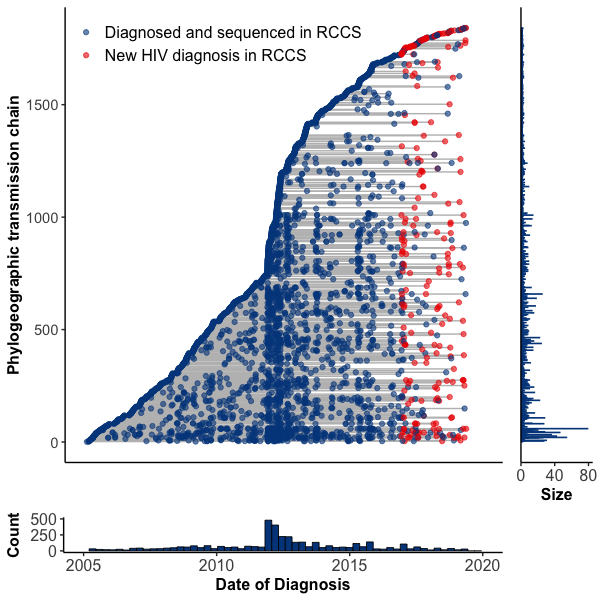
Among 22,593 RCCS participants, 4,215 were living with HIV; 435 were newly diagnosed between Dec 2016 and May 2019, of whom 252 had at least one pure subtype p24 or gp41 sequence available for phylogenetic analyses. We identified 910 clusters and 1,841 phylogeographic transmission chains; most clusters and chains were small (median size 2–3), and new diagnoses were broadly dispersed across them, indicating little evidence of large recent outbreaks. Sixty-one percent of new diagnoses belonged to lineages transmitting before 2016, while the remainder were phylogeographically linked to external introductions. Mixed-subtypes/recombinant chains were larger and had higher case reproduction numbers (A1/D: 0.84 [95% CL 0.80-0.89]; other mixed: 0.90 [0.81-1.00]) than single-subtype chains (A1: 0.57 [0.53-0.61]; D: 0.6 [0.56-0.64]; C: 0.57 [0.44-0.72]), yet all estimates were less than 1. New diagnoses were more likely to occur among recent migrants (p-value<0.0001), consistent with geographically diffuse transmission and the role of mobility.
Conclusions
In this setting with universal treatment access and declining incidence, HIV transmission was fragmented across numerous, slowly propagating lineages, maintained by persistent local clusters and recurrent introductions. Sustaining high levels of viral suppression is critical to avert resurgence. Because transmission is diffuse, widespread delivery of prevention interventions may be essential.
Table or Figure