Background
Persistent anal HPV16 infection is a key risk factor for anal cancer, especially in people living with HIV (LWH)(1). Transgender women (TGW), regardless of HIV status, are at high risk for anal cancer(2). While elevated testosterone levels have been linked to increased anal HPV prevalence in TGW and cisgender men who have sex with men (MSM), the role of sex-hormones in persistent infection is unclear(3,4). We conducted a longitudinal cohort study to assess factors associated with persistent HPV16 and abnormal anal cytology (AAC) in TGW.
Methods
TGW and MSM were recruited from two academic-community clinics in Baltimore, MD and Washington, DC. Participants completed annual visits with anal swabs for HPV testing (Roche Cobas®), anal cytology, serum hormone levels, HIV testing, and behavioral surveys. HPV testing identified HPV16 using a PCR assay. AAC was defined as atypical squamous cells of undetermined significance, low or high-grade squamous intraepithelial lesions. For each participant, we averaged estradiol and testosterone levels (AEL and ATL) at baseline and month 12 as a reflection of exogenous hormone use. Fisher’s Exact test was used for this interim analysis.
Results
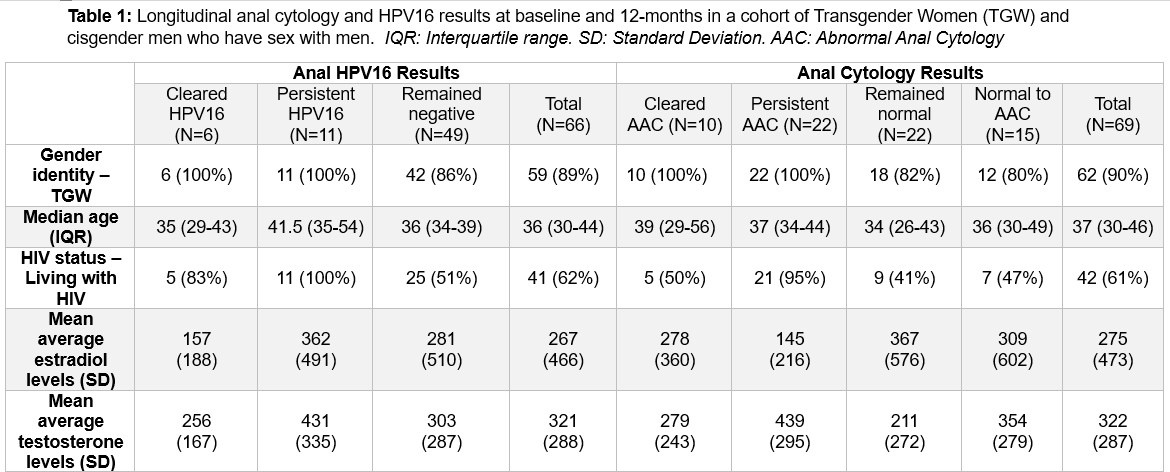
Among 66 participants with adequate testing at baseline and 12 months (Table 1), 17 (26%) had baseline HPV16. At month 12, HPV16 persisted in 11 (65%) and cleared in 6 (35%). HIV status and mean AEL and ATL were not significantly different when comparing those with persistent or cleared HPV16 (p=0.35; 0.36; 0.25). For cytology, 32 (46%) had baseline AAC, which persisted in 22 (69%) and resolved in 10 (31%) at 12 months. LWH was significantly associated with persistent AAC: 81% of those LWH with baseline AAC had persistent AAC vs 17% of those without HIV with baseline AAC (p<0.001). Mean AEL and ATL were not significantly different when comparing those with persistent or cleared AAC (p=0.22; 0.59)
Conclusions
In this interim analysis, most participants with HPV16 or AAC at baseline showed persistence of both at 12 months. Although the sample size is limited, HIV status was associated with persistent AAC among TGW, while sex-hormone levels were not associated with the persistence of HPV16 or AAC. Understanding the interplay between HIV and exogenous hormone therapy is essential for targeted anal cancer prevention strategies in TGW, especially those LWH.
Table or Figure