Background
In low- and middle-income countries (LMICs), varying rates of emerging resistance to integrase inhibitors (INI) have been reported, but knowledge on INI mutational patterns and associated clinical factors remains limited. We herein evaluated INI-resistance and associated clinical factors among people with HIV (PWH) who failed dolutegravir (DTG)-based antiretroviral therapy (ART) in Cameroon, a country with a broad non-B HIV-1 diversity.
Methods
This study was conducted among PWH who failed (viral load [VL] ≥1000 copies/ml) a DTG-ART (without previous INI-exposure) from January 2020 through May 2025 and for whom a genotypic resistance test (GRT) including integrase was performed. HIV Drug Resistance was interpreted using Stanford HIVdb.v.9.8; Chi square/Fisher’s and T Student tests used to evaluate factors associated with resistance.
Results
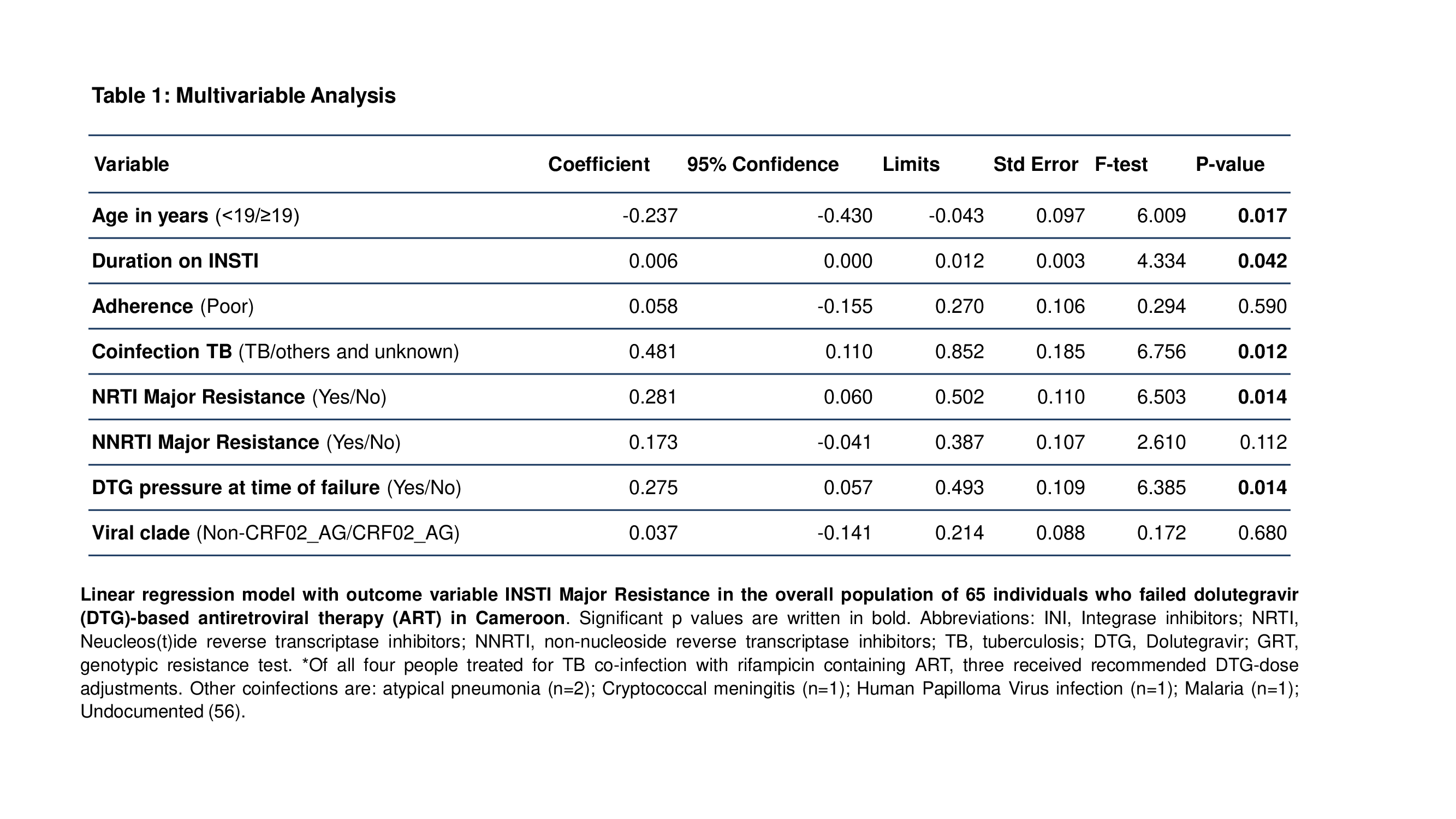
Overall, 65 PWH failed DTG-ART (median [IQR] duration: 20 [11–34] months), with a median [IQR] age of 21 [17-44] years, 50.8% women. CRF02_AG was the prevailing clade (n=36; 55.4%). At GRT, the median [IQR] VL was 4.7 [3.8-5.2] log cps/mL, with 50 PWH still under DTG (Group A), and 15 empirically transitioned to non DTG-ART (Group B, median duration since DTG-withdrawal, 21 [11-34] months). Overall INI-resistance was 29.2% (19/65), exclusively found in Group A (19/50 [38.0%] vs 0/15 [0%] in Group B; p=0.003). Within Group A, a higher INI-resistance rate was associated with being adult (≥19 vs ˂19 years: 58.6% vs 41.3%, p˂0.001), and a longer exposure to INI (34 [18-48] vs 20 [11-33] months, p=0.046). Four PWH treated with rifampicin-containing regimens for tuberculosis (TB) all presented INI-resistance. Individuals with INI-resistance had a higher rate of NRTI (100.0% vs. 58.1%, p<0.001) and NNRTI (94.7% vs. 61.3%, p=0.009) resistance. Following multivariable analysis, most factors were independently associated with INI-resistance (Table 1). Despite no significant association between subtypes and INI resistance mutations (RMs), G118R+≥1RM was most frequent (n=11, 7 in CRF02_AG), followed by R263K±1RM (n=5, 4 in non-CRF02_AG), with overall higher resistance scores in AG recombinants.
Conclusions
Among PWH failing DTG in this real-life setting, INI-resistance rate is consistent, and higher in adults, with longer DTG-duration, NRTI-resistance and in TB co-treatment with rifampicin. Hence, prioritising GRT-guided ART in these vulnerable PWH and limiting DTG use with rifampicin-containing regimens would contribute to mitigating INI-resistance in LMIC.
Table or Figure