Background
HIV viral suppression is key to ending the HIV epidemic and maintaining the health of people with HIV (PWH). While prior research links substance use (SU) to lower antiretroviral therapy (ART) adherence, and higher HIV viral loads (VL) in PWH, newer ART regimes may be more resilient to intermittent adherence. We examined associations between active SU and VL suppression in the current ART era across 6 cohorts.
Methods
Cohorts included: ALIVE, CNICS, JHHCC, MASH, mSTUDY, and RADAR. PWH with at least one VL from 2010 onward were included, and SU reported at the time of or up to 6 months prior to measurement of VL was included. Prevalence ratios (PR) for viral suppression, dichotomized VL at 200 copies/mL (except for ALIVE, where a 400 copies/mL cutoff was used per study protocol) were obtained using a generalized linear model, adjusting for age, gender, race/ethnicity, and visit year. Each cohort was analyzed independently, with summary estimates obtained through meta-analysis.
Results
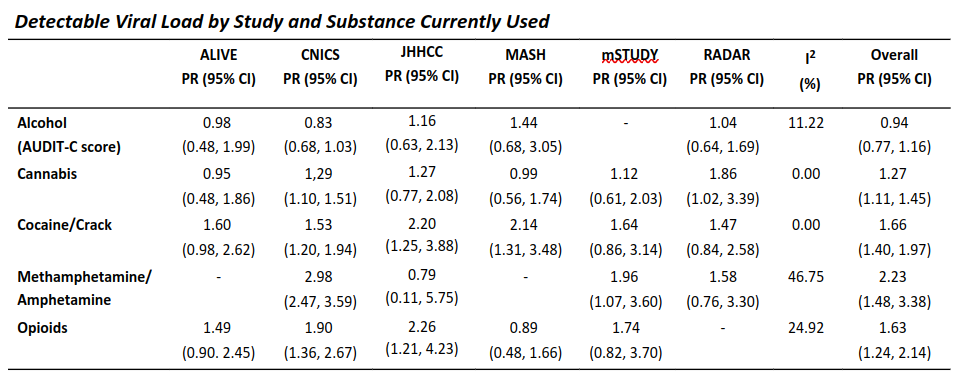
Of 10,406 PWH, the mean age was 51 years; 2% were gender diverse, and 35% reported White, 46% Black, 14% Latine race/ethnicity, respectively. Adjusted models estimated higher probability of detectable VL among PWH reporting recent SU: cocaine/crack PR=1.7 (95% CI 1.4-2.0), opioids 1.6 (95% CI 1.2-2.1) and cannabis 1.3 (95% CI 1.1-1.5). PWH who used methamphetamine were 2.2 times more likely to have unsuppressed VL compared to non-users (95% CI 1.5-3.4). Associations between SU and viral suppression were broadly comparable across study populations. While the prevalence of SU varied across subgroups, SU was consistently associated with viral nonsuppression in each of the studies.
Conclusions
Our results demonstrate that SU is strongly associated with a lack of viral suppression across key demographic subgroups and substances used in the US, even in the current ART era. Methamphetamine use had the greatest impact on these negative outcomes. While there was no observed association with alcohol use in this analysis, the mean AUDIT-C score of 2 suggests that these results apply primarily to light drinkers (median 1, SD 2; IQR: 0, 3).
Table or Figure