Background
Developing functional HIV cure strategies remains a top research priority. Despite promising results from a recent combination immunotherapy trial (NCT04357821, the UCSF-amfAR trial), including a boosted vaccine, TLR9 agonist, and two doses of dual broadly neutralizing antibodies (bNAbs, VRC07-523LS and 10-1074) prior to and at the time of antiretroviral treatment interruption, it remains unclear whether residual bNAbs in tissue contribute to sustained virologic control. Here we examined if VRC bNAbs persisted in tissue collected from UCSF-amfAR trial participants using a VRC-developed anti-bNAb idiotype antibody (5C9, broadly binding to VRC bNAbs).
Methods
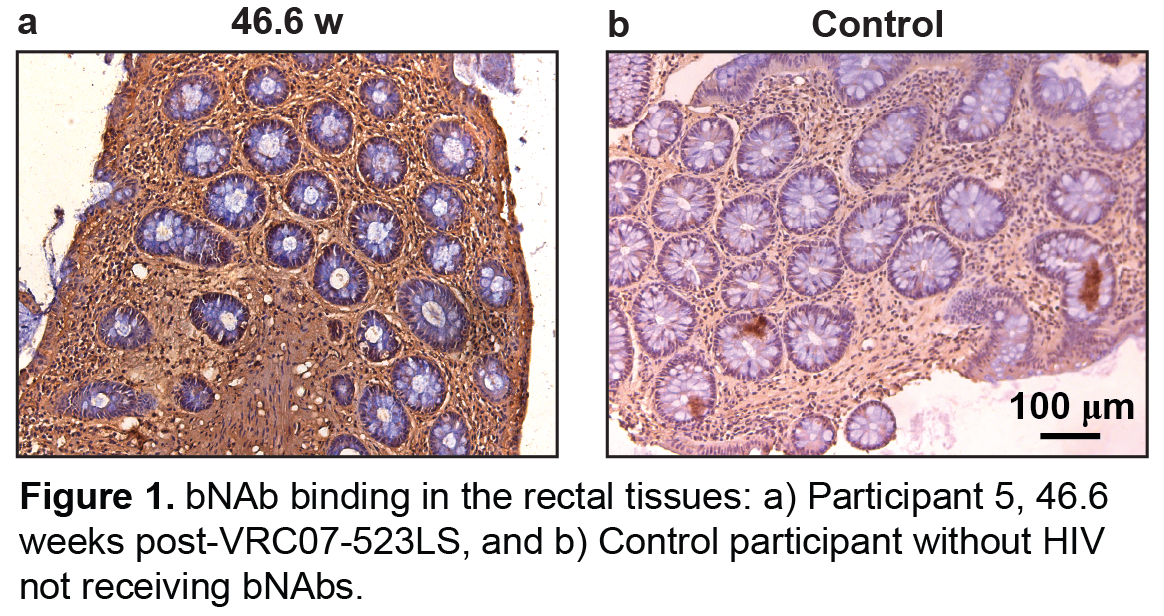
Formalin-fixed paraffin-embedded rectal biopsieswere collected 26-51 weeks following VRC07-523LS administration from six participants (26.9, 29.0, 43.0, 46.1, 46.6, and 51.1 weeks post-bNAb, participants 1-6, respectively), and from three control participants without HIV not receiving bNAbs. For immunohistochemistry (IHC) imaging, sections were subjected to antigen retrieval with pepsin, and incubated with 5C9 primary antibody overnight. Sections were incubated with secondary antibody, stained, counterstained, and mounted. Staining intensity of anti-bNAb binding was manually evaluated by three blinded researchers with a scale of 0 (no stain) to 5 (strongest).
Results
IHC of rectal tissues revealed localized binding of 5C9 up to 46 weeks post VRC07-523LS infusion, indicating tissue penetration and retention of bNAbs in both parenchymal and perivascular regions (Fig 1a). Staining intensity scores were 4, 5, 3, 2, 5 for samples collected between 26.9-46.6 weeks post-bNAb (participants 1-5, respectively). Reduced staining was observed for a biopsy collected 51 weeks post infusion (participant 6, score 1) and for 3 control samples (scores 1-2) (Fig. 1b). Population pharmacokinetic (PK) model predicted plasma levels of VRC07-523LS were low and likely subtherapeutic: 8.5, 5.1, 0.7, 0.9, 2.2, and 0.6 µg/mL for participants 1-6, respectively, generally aligning with tissue scoring.
Conclusions
IHC staining demonstrated presence of bNAbs up to 46 weeks post-VRC07-523LS administration. There is a need to perform mass spectrometry-based quantitation of VRC07-523LS in tissue and future studies should delineate VRC07-523LS and autologous antibodies that may cross-react with these probes. This study underscores the importance of bNAb tissue PK in HIV cure trials to understand underlying mechanisms of post intervention control.
Table or Figure