Background
Long-acting injectable cabotegravir (CAB-LA) as HIV Pre-exposure Prophylaxis (PrEP) demonstrated superiority over daily oral tenofovir disoproxil fumarate–emtricitabine (TDF/FTC) in the HPTN 083 trial and 96% of participants in the open label extension chose CAB-LA over TDF/FTC. We used data from the HPTN 083 TDF/FTC adherence cohort to estimate the population-level impact of different CAB-LA prioritization strategies on HIV incidence, including a low TDF/FTC adherence scenario intended to ensure access to CAB-LA to those who most urgently need it.
Methods
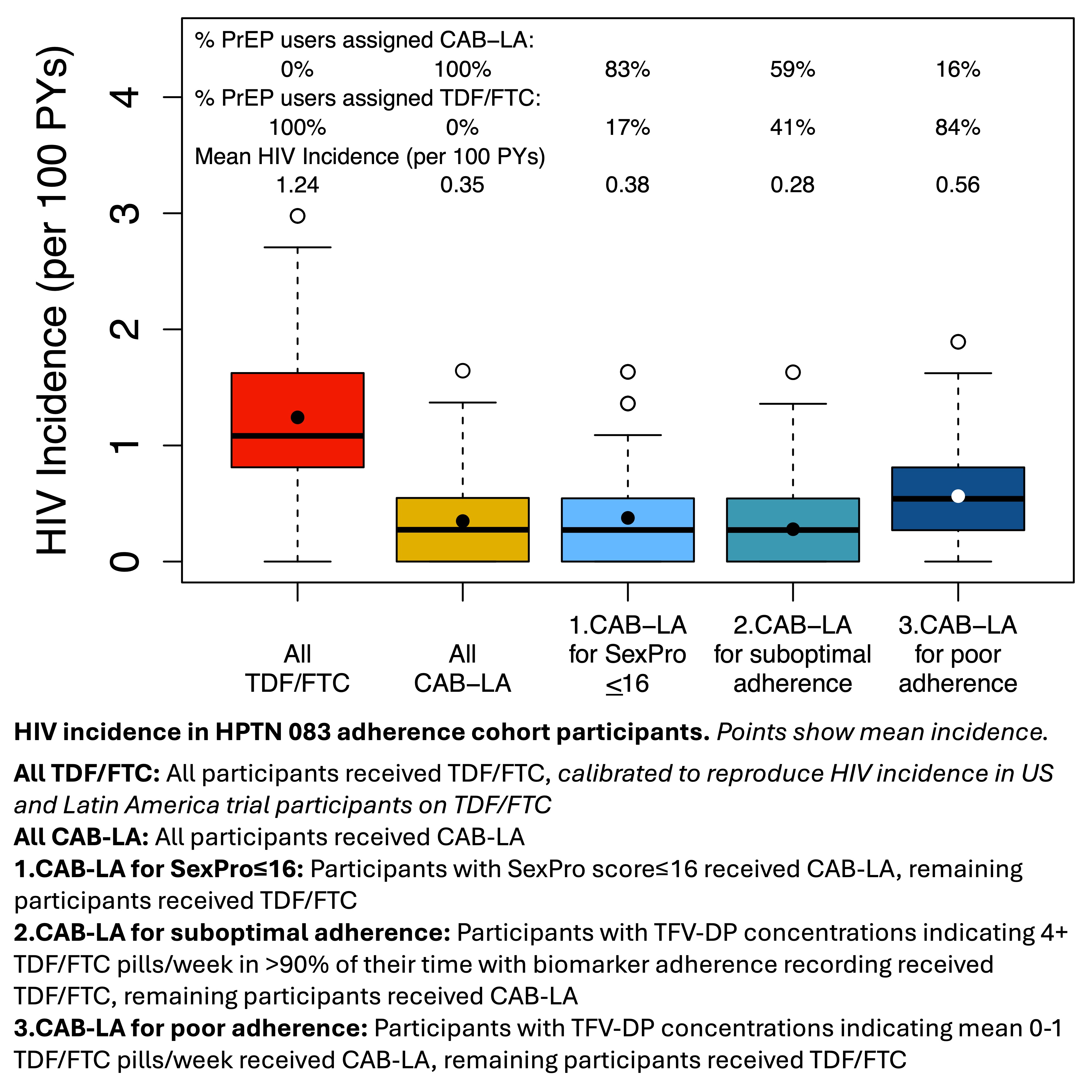
The adherence cohort (n=390, n=281 with SexPro scores and 3+ placebo injection visits included in analysis) were offered active TDF/FTC and placebo CAB-LA with dried blood spots (DBS) collected as a biomarker for adherence evaluation. For each cohort participant, we estimated the effectiveness of active CAB-LA and TDF/FTC as predicted protective coverage over their follow up period. Projected time-varying CAB-LA efficacy was modeled based on the time since the last placebo injection. TDF/FTC efficacy was modeled with the intraerythrocytic tenofovir diphosphate (TFV-DP) concentrations in DBS. We used a mathematical model accounting for differences in risk of HIV acquisition between participants to simulate HIV incidence in this cohort and calibrated it to match 1.24/100 PYs incidence observed in the HPTN 083 TDF/FTC arm. SexPro score and TFV-DP concentrations (indicating TDF/FTC uptake/persistence) were used to prioritize individuals to CAB-LA in three subgroups: SexPro score ≤16, suboptimal TDF/FTC adherence (<4 pills/week), or poor TDF/FTC adherence (0-1 pills/week), with remaining participants receiving TDF/FTC.
Results
We estimated mean effectiveness of 93% (CAB-LA) and 72% (TDF/FTC) in the TDF/FTC adherence cohort. HIV incidence was estimated at 0.35/100 PYs when all participants were offered CAB-LA. If CAB-LA was prioritized to the 83% of participants with SexPro score ≤16, the 59% with suboptimal TDF/FTC adherence, or the 16% with poor TDF/FTC adherence, incidence was predicted to be 0.38, 0.28, and 0.56/100 PYs, respectively.
Conclusions
Prioritizing CAB-LA based on SexPro score or suboptimal TDF/FTC adherence could achieve a reduction in HIV incidence comparable to providing CAB-LA to all participants. Ideally CAB-LA would be provided based on user preference, but while programmatic access potentially limits its use, this analysis may inform optimal prioritization strategies in settings with resource constraints.
Table or Figure