Background
People with HIV (PWH) in the US experience homelessness at greater proportions than the general population. There remains a lack of understanding regarding HIV clinical care outcomes, including achievement of viral suppression, among PWH experiencing homelessness in different settings.
Methods
We evaluated associations between housing status and HIV viral suppression using harmonized data from four observational and clinical cohorts of PWH across the US, including three from the HIV & Substance Use Cohort Coordinating Center (HIV SUCCESS): AIDS Linked to the IntraVenous Experience (ALIVE), Miami Adult Studies on HIV (MASH), and Johns Hopkins HIV Clinical Cohort (JHHCC); and the Centers for AIDS Research Network of Integrated Clinical Systems (CNICS) cohort. Data were drawn from clinical records, laboratory testing, and patient-reported measures and outcomes (PROs) collected between 2010-2024, including self-reported recent homelessness (in the past month or 6 months). We estimated prevalence ratios (PR) and 95% confidence intervals (CI) for the association between most recently reported homelessness and HIV viral suppression (<400 copies/mL) using relative risk regression with robust standard errors. Separate models for each cohort were adjusted for age, sex, and year, along with site for CNICS. Results for each cohort were pooled using fixed-effects meta-analysis to obtain an overall summary estimate.
Results
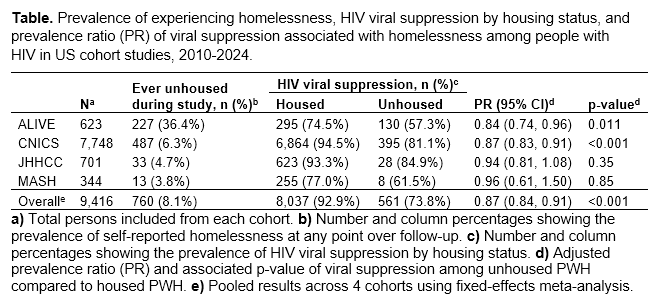
Among a total of 9,416 PWH (79% male, 21% female) across all 4 cohorts, 760 (8.1%) reported experiencing homelessness on at least one occasion during study follow-up (Table). Across cohorts, unhoused PWH had a lower prevalence of HIV viral suppression compared to housed PWH (ALIVE: PR=0.84, 95% CI: 0.74, 0.96; CNICS: PR=0.87, 95% CI: 0.83, 0.91; JHHCC: PR=0.94, 95% CI: 0.81, 1.08; MASH: PR=0.96, 95% CI: 0.61, 1.50). In the overall pooled results, experiencing homelessness was associated with a 13% lower prevalence of HIV viral suppression compared to having housing (PR=0.87, 95% CI: 0.83, 0.91).
Conclusions
Experiencing homelessness was associated with a lower prevalence of HIV viral suppression in cohorts of PWH in the US. These results highlight that lack of access to stable housing is deleterious to successful management of HIV and a barrier to ending the HIV epidemic.
Table or Figure