Background
At 56 Dean Street (56DS), a combined sexual health and HIV service in London, UK, the proportion of individuals newly diagnosed with HIV (INDwH) who have previously used PrEP has risen.
Various factors cause inconsistent PrEP use including adherence, side-effects, formulation and availability; all reducing the effectiveness of HIV combination prevention.
We present data on prior PrEP use in individuals newly diagnosed with HIV including patterns of PrEP use and adherence.
Methods
We performed a retrospective case-note review of INDwH at 56DS from 1st January 2017 to 31st December 2024, collecting demographics, prior PrEP use, adherence and reasons for PrEP discontinuation. Recently acquired HIV was defined as a negative test within 1 year or according to avidity testing. Sub-optimal PrEP use is defined as PrEP discontinuation or sub-optimal adherence in those still taking PrEP. Statistical analysis was done using chi-square (discrete data) and Mann-Whitney U tests (continuous data).
Results
The number of PrEP users at 56DS rose from 170 in 2017 to 24,487 in 2024.
Of 1081 INDwH, 211 (19.5%) had prior PrEP use (201, cisgender gay-and-bisexual-men-who-have-sex-with-men; 9 transgender women; 1 cisgender heterosexual man). Compared with ‘never PrEP users’, those with prior PrEP use were more likely to have recently acquired HIV (85.8% vs 58.0%) and previously attended 56DS (70.1% vs 37.7%) (both p<0.00001). There were no differences in age, ethnicity or country of birth.
Annual proportion of INDwH with prior PrEP use rose from 9/209 (4.3%) in 2017 to 50/82 (61%) in 2024.
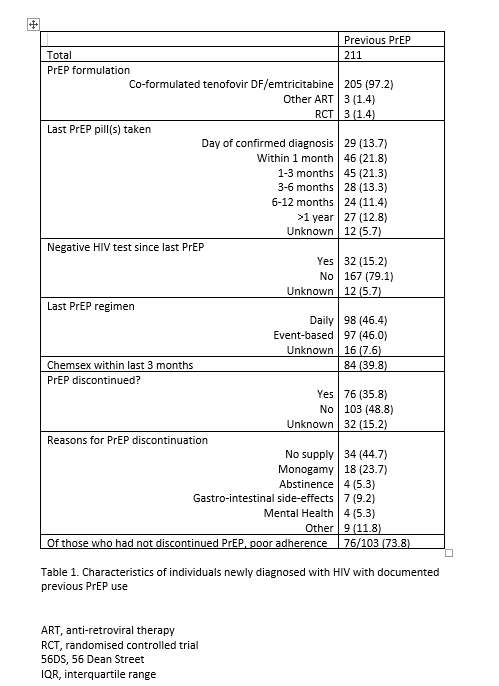
Prior PrEP users all used oral PrEP. Last reported PrEP regimen: daily (98, 46.4%), event-based (97, 46.0%), unknown (12, 5.7%). The last PrEP dose was taken on day of confirmed HIV diagnosis (29, 13.7%) and in the last 3 months (91, 43.1%) (Table 1).
Most, 152 (72.0%), reported sub-optimal PrEP use: 76 had discontinued PrEP and of the 103 still taking PrEP, 76 (73.8%) reported sub-optimal adherence. Main reasons for PrEP discontinuation were having run out of PrEP (34, 44.7%), monogamy (18, 23.7%), gastro-intestinal side-effects (7, 9.2%) and abstinence (4, 5.3%).
Conclusions
A rising proportion of INDwH at 56DS report prior PrEP use with most reporting sub-optimal adherence or discontinuation. This suggests the need for improved ways to address barriers including consistent PrEP access and support PrEP persistence. Wider availability of long-acting formulations may offer a more clinically effective option to address this.
Table or Figure