Background
Adolescents with perinatally-acquired HIV (APHIV) have lower retention and viral suppression rates during and after transitioning to adult care; interventions to support the transition process are needed.
Methods
We conducted a hybrid implementation-effectiveness, stepped-wedge, cluster-randomized trial to assess the effectiveness of in-person vs virtual adolescent-friendly transition interventions (InTSHA-VIP) on viral suppression (viral load <200 copies/ml) and retention (composite of >80% on time pharmacy refills and >80% of scheduled clinic appointments attended) in APHIV aged 15-19 in 16 clinics in urban and rural KwaZulu-Natal, South Africa. InTSHA VIP uses facilitated discussion groups to improve peer support and connection to clinical staff. Clinics were cluster randomized (immediate/delayed intervention, in-person/virtual). We evaluated transition readiness at baseline with the HIV Adolescent Readiness for Transition Scale. Adolescents with low/intermediate readiness scores were offered enrollment into the InTSHA VIP intervention, while those with high scores were placed in an observational cohort. We present outcomes after 9 months, where the immediate group completed the InTSHA VIP intervention and the delayed group remained in standard of care. We used logistic regression to evaluate viral suppression and retention adjusting for age, sex, alcohol/substance use, and depression.
Results
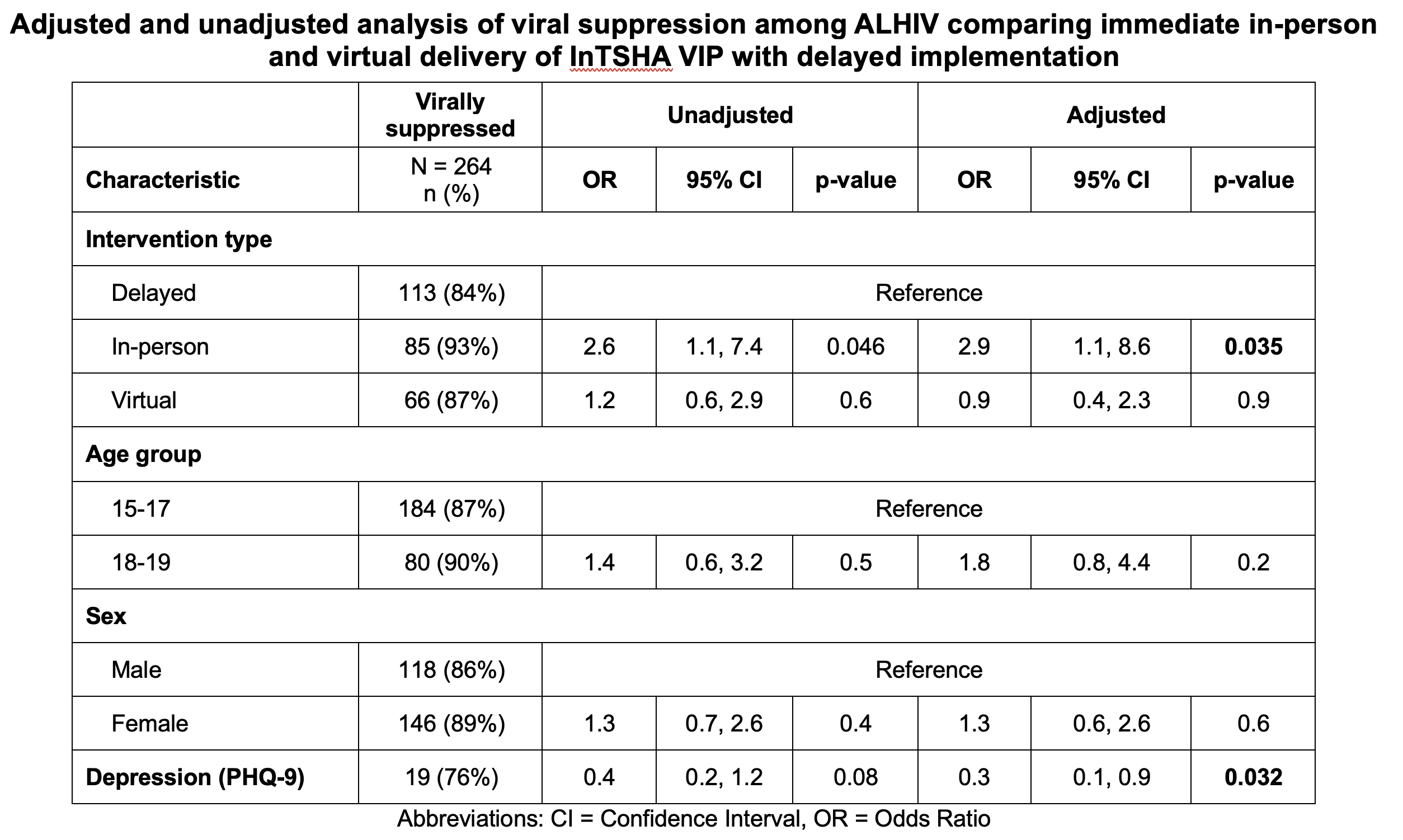
We enrolled 372 APHIV including 48 (13%) in the observational cohort, 178 (48%) in the immediate and 146 (39%) in the delayed group. Of the adolescents enrolled in the immediate group, 83 (47%) were virtual and 95 (53%) in-person. After 9 months, the in-person group had significantly higher viral suppression 85 (93%) compared to the delayed group 113 (84%) (AOR 2.9; 95% CI 1.1 – 8.6; p=0.035) while virtual 66 (87%) was not significant (AOR 0.9; 95% CI 0.4 – 2.3; p=0.9). Retention was higher for both in-person 26 (27%) and virtual 47 (57%) compared to delayed 19 (13%) (AOR 2.7; 95% CI 1.4 – 5.5; p=0.004 and AOR 7.7; 95% CI 3.9 – 16.0; p<0.001, respectively).
Conclusions
The InTSHA-VIP intervention significantly improved viral suppression and retention in care compared to standard care, demonstrating its effectiveness in supporting APHIV during transition. Ongoing evaluation of implementation factors and comparison of in-person versus virtual delivery in subsequent trial steps will guide scalable strategies to optimize adolescent HIV transition outcomes.
Table or Figure