Background
The freezing of U.S. government (USG) foreign assistance funds on January 20, 2025, marked a pivotal shift for HIV programs globally, resulting in clinic closures, staff layoffs and interruptions in HIV-related service delivery and research. To document the status of HIV-related service delivery in mid-2025, the International epidemiology Databases to Evaluate AIDS (IeDEA) research consortium conducted a rapid stock-taking survey among HIV clinics and programs participating in IeDEA.
Methods
From June-July 2025, survey links were distributed to 92 HIV clinics and 11 HIV programs representing multiple individual clinics, all actively contributing to IeDEA in 2025. Survey domains included USG funding-related disruptions in HIV service delivery, essential medication availability, laboratory services and clinic operations. Responses were received from 68 clinics (74%) and 8 programs (73%) in 32 countries in sub-Saharan Africa, Latin America, and the Asia-Pacific. Descriptive statistics were used to characterize survey respondents and disruptions in HIV-related care, overall and stratified by country PEPFAR support status as of January 2025, with clinic and program responses weighted equally.
Results
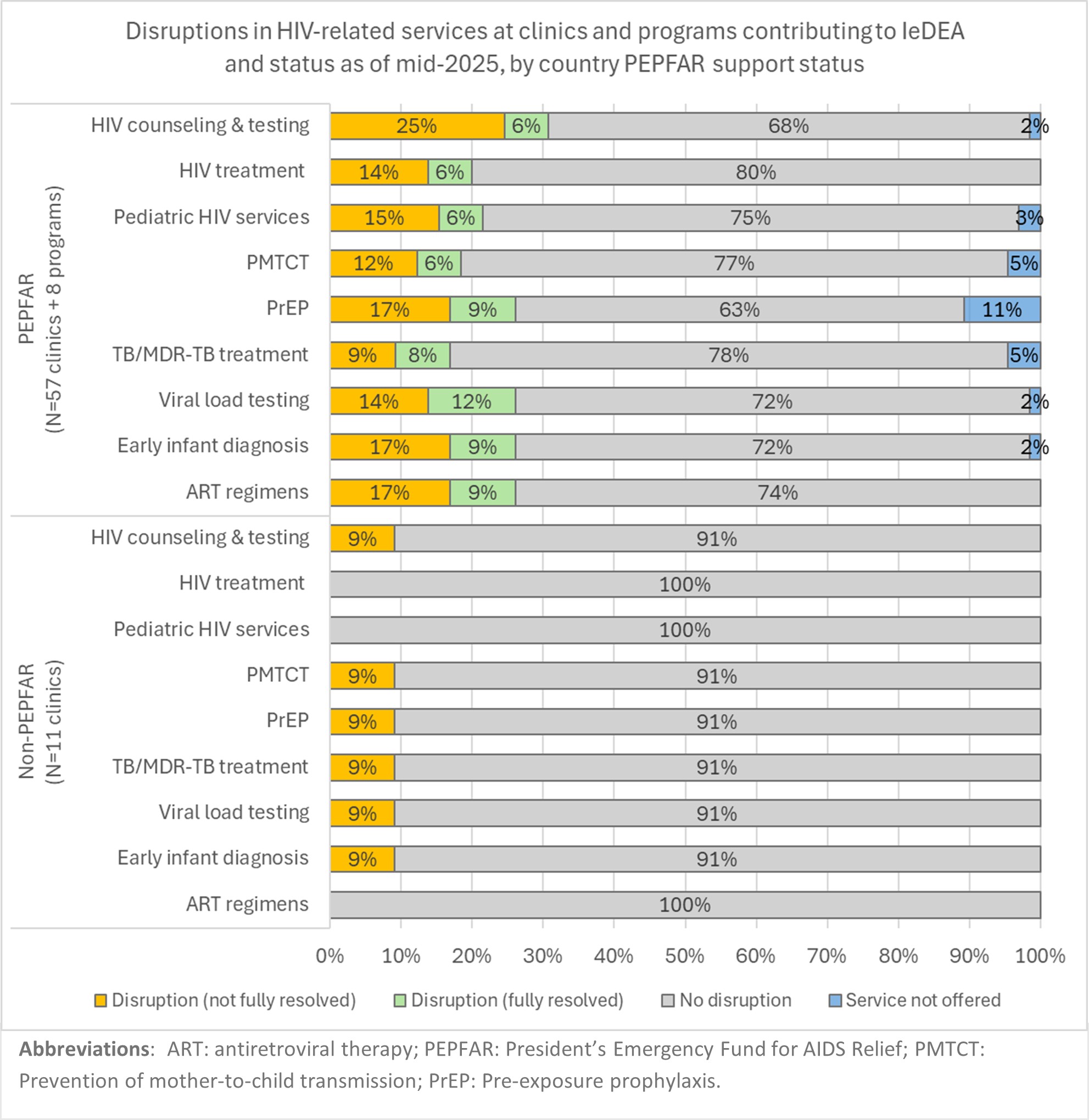
Respondents were mainly from hospitals (58%) in urban/mostly-urban settings (86%) and in countries with active PEPFAR support (86%) at the beginning of 2025. Substantial proportions reported disruptions in HIV-related service delivery (47%), medication availability (28%), laboratory services (34%) and other clinic operations (62%). Disruptions in HIV-related services predominantly occurred among clinics and programs in PEPFAR-supported countries (Figure). In these settings, almost one-third of respondents reported disruptions in HIV counseling and testing, and 18-27% reported disruptions in the provision of pre-exposure prophylaxis, HIV treatment services, pediatric HIV services, prevention of mother-to-child-transmission, viral load testing, early infant diagnosis, and 26% reported stockouts of ART regimens. Most disruptions occurring since January 2025 in these settings had not been fully resolved by mid-2025.
Conclusions
While our equal weighting of clinic and program responses may underestimate the impacts of recent funding freezes, widespread and ongoing disruptions in care reported by this diverse global cohort are causes for concern. Continued monitoring of the HIV response is vital for understanding population-level impacts of these funding shifts.
Table or Figure