Background
Point-of-care (POC) diagnostics are central to the World Health Organisation (WHO) advanced HIV disease (AHD) care package, but their effectiveness in real-world programs is limited by implementation gaps that reduce test performance. We evaluated challenges in POC cryptococcal antigen (CrAg) and CD4 testing across three Médecins Sans Frontières (MSF) supported programs.
Methods
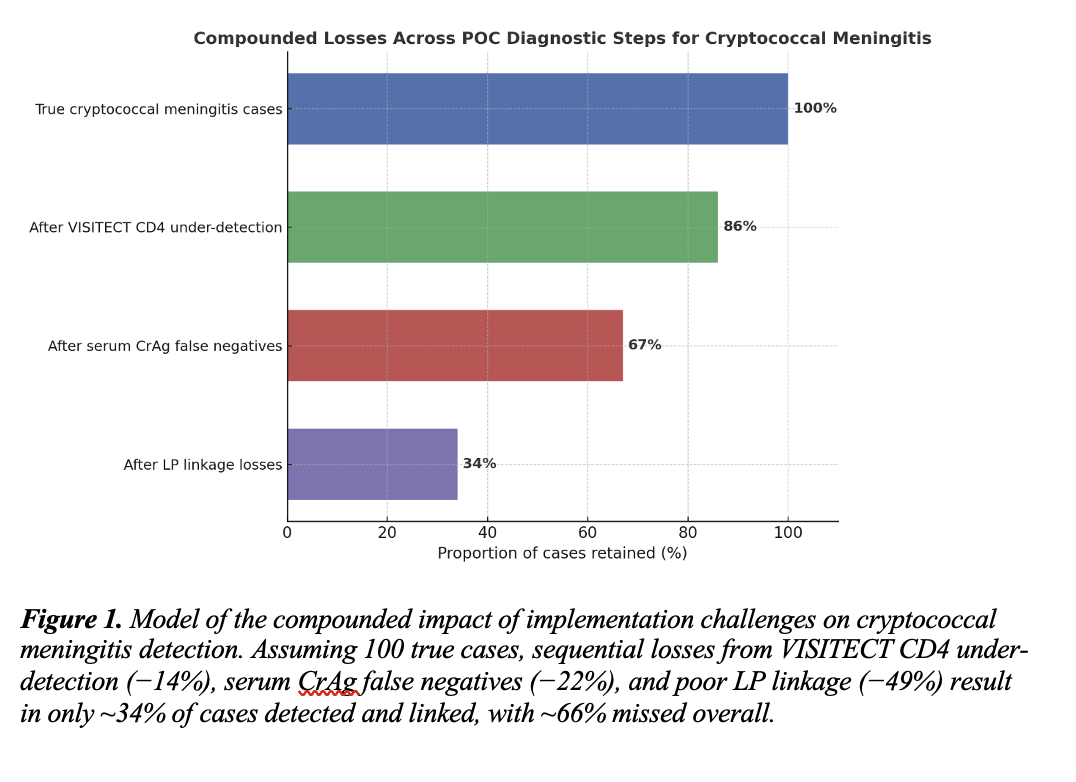
Evaluations were conducted in Guinea, Democratic Republic of Congo (DRC), and Mozambique. In Guinea, lay workers performed decentralised CrAg screening in peripheral clinics, assessed for concordance with central laboratories and linkage to lumbar puncture (LP). In the DRC, serum CrAg testing by nurses at inpatient triage was compared against cerebrospinal fluid (CSF) confirmed cryptococcal meningitis, with structured observations to assess procedure fidelity. In Mozambique, VISITECT CD4 lateral flow assays were run in parallel with PIMA (automated CD4) in a public hospital to compare detection of CD4 <200 cells/μL. The compound impact of reductions in test performance on cryptococcal meningitis detection was modelled assuming sequential CD4 testing, CrAg testing for those with low CD4 counts, and LP completion.
Results
In Guinea, 1,177 CrAg tests were performed in primary care clinics with 2.5% positivity (30/1,177). At baseline, linkage to LP was 51% (20/39) and concordance with central labs 58% (7/12). With referral and transport support, linkage rose to 86% (12/14) and concordance to 92% (11/12). In the DRC, 22% (47/218) of cryptococcal meningitis cases had false-negative serum CrAg at triage. Procedural errors like insufficient volume and reading errors were common; extrapolating this 22% false-negative rate to 4,023 triage CrAg tests suggested 152 additional cases may have been misclassified. In Mozambique, PIMA identified CD4 <200 cells/μL in 45% (234/517) versus 32% (160/508) with VISITECT (χ²=19.9, p<0.001).
Conclusions
Procedural failures with POC tests risk missing diagnoses and delaying care. VISITECT failed to identify 1 in 7 patients as AHD in contrast to prior validation studies where VISITECT overestimated AHD burden due to reduced specificity. Using cryptococcal meningitis as an example, the compound of these failures could result in as many as 66% of true cases being missed due to POC challenges. Strengthening referral pathways, task shifting to a new cadre to ensure fidelity to test procedures, and deploying adjuncts such as cube readers are critical to ensure POC testing performs effectively.
Table or Figure