Background
The mechanisms that drive SARS-CoV-2-related cardiovascular complications of Long COVID (PASC) such as atherosclerotic cardiovascular disease (CVD) remain unclear. Prior studies have shown alterations of HDL function in infections and SARS-CoV-2 infection, persistent oxidative stress, lipid abnormalities and macrophage dysfunction post COVID-19 that may contribute to HDL dysfunction and CVD. However, the effect of dysfunctional HDL on atherogenesis in PASC remains unknown. To address these gaps in knowledge, we used an established model of atherogenesis to assess ex vivo the role of impaired HDL on early atherogenesis in PASC.
Methods
Our in vitro model of atherogenesis can dissect the impact of HDL from patients with PASC on key mechanisms of early atherogenesis such as transendothelial migration of monocytes (TEM) and monocyte-derived foam cell formation (MDFCF). ApoB depleted serum was isolated from healthy participants (n=15 males, 18-40 years old) and patients with PASC (n=15, 40-55 years old, 7 females, 8 males) with no risk factors for CVD or inflammatory comorbidities other than SARS-CoV-2 infection >12 weeks prior to study participation. Study participants were recruited within UCLA CTSI. PBMCs from healthy donors (n=15) or PASC patients were added to activated endothelial cells monolayers (HUVECs) on collagen gels and flow cytometry assessed % TEM of monocytes and MDFCF (BODIPY signal compared to staining control in the presence of ApoB depleted serum as previously (PMID: 28926407).
Results
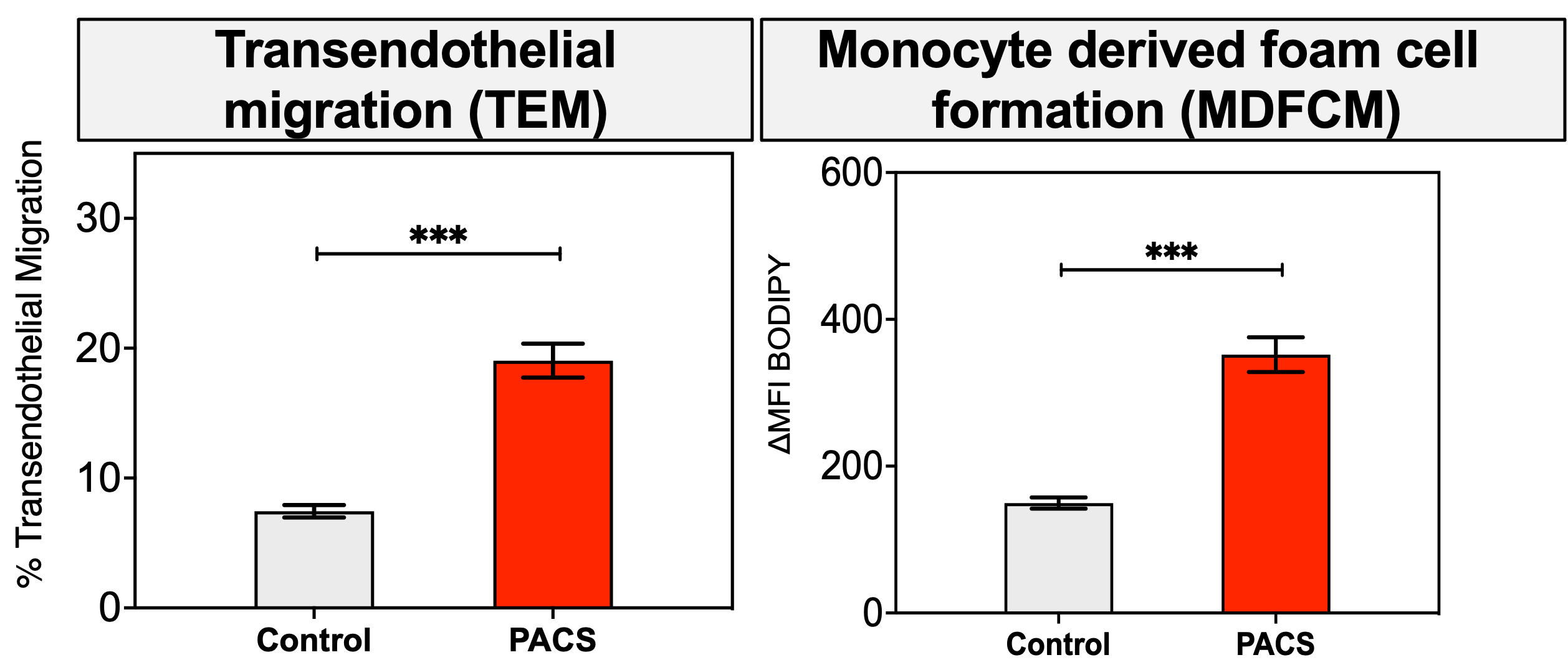
When media-containing PACS+ ApoB depleted serum was added to HUVECs and autologous PASC PBMC, a significantly increased proportion of monocytes underwent TEM(median migrated cells 19.04 vs. 7.5%, respectively) and CD33+ macrophages inside the collagen gel had increased lipid content per cell (median ∆MFI BODIPY 351.9 vs. 149.7, respectively)(P<0.001) compared to control ApoB depleted serum and healthy PBMCs, respectively (Figure).
Conclusions
ApoB depleted serum from patients with PASC with no CVD and CVD risk factors directly induces key mechanisms of early atherogenesis (TEM and MDFCF) in a mechanistic ex vivo assay of atherogenesis in the presence of autologous PBMCs from the same PASC patients, suggesting that impaired HDL interacts with impaired monocytes to potentially contribute to atherogenesis in the setting of PASC. Further large studies in patients with PASC are needed to validate the role of dysfunctional HDL in Long COVID and recurrent SARS-CoV-2 infections.
Table or Figure