Background
In Italy, particularly in the North, the COVID-19 pandemic have significantly affected access to healthcare services, including HIV screening and management of people with HIV (PWH). We compared data from two clinical centres, one in the North and one in the Centre of Italy, regarding newly diagnosed people with HIV (ndPWH), before, during and after the pandemic. We examined clinical presentation at diagnosis and time to virological success (VS) at 12 months after starting ART.
Methods
We conducted a retrospective observational study involving PWH diagnosed between 2015 and 2023 at two large referral centres. Participants, who had at least two HIV-RNA measurements within 12 months, 6±2 months apart, were categorized into pre-pandemic (2015-2017 and 2018-2019), pandemic (2020-2021) and post-pandemic (2022-2023) periods. Kaplan-Meier analysis assessed the probability of achieving overall VS at 12 months (HIV-RNA≤50 cps/mL) and Cox-regression identified potential predictors of VS.
Results
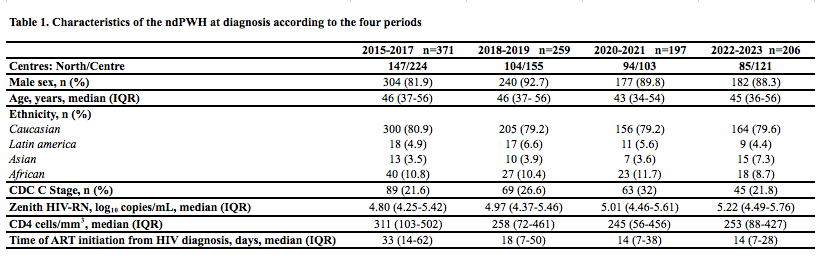
We enrolled 1.033 ndPWH, main characteristics are shown in Table 1. NdPWH during pandemic were younger (p=0.050) and had a higher viral zenith (p<0.001) compared to those diagnosed pre-pandemic. The frequency of CDC C peaked during the pandemic (32%) (p=0.031). During the pandemic period, the use of triple therapy declined markedly (p<0.001) while dual therapies as first line regimen increased (p<0.001). The overall probability of experiencing VS was 96.6%, with no significant differences between the periods (p=0.453). This was confirmed by multivariable Cox regression, adjusted for age, sex, time to ART initiation, (p=0.448). A higher viral zenith (aHR 0.68, 95%CI 0.64-0.73, p<0.001), CDC C (aHR 0.81, 95%CI 0.69-0.96, p=0.014), being treated in the northern centre (aHR 0.74, 95%CI 0.65-0.85, p<0.001) were associated with a lower likelihood of VS while higher nadir in CD4 count (aHR 1.04, 95%CI 1.01-1.07, p=0.007) and triple therapy INSTI-based regimens (aHR 1.67, 95%CI 1.43-1.96, p<0.001) were related to a higher probability of achieving VS.
Conclusions
In this two-centre observational study, we found that ndPWH diagnosed during pandemic had worse initial clinical and viro-immunological conditions. However, this did not impact virological response, likely due to the increasing availability of third-generation INSTIs in the recent years. Northern centre’s participants had a lower likelihood of VS, possibly reflecting other unexplored confounders in addition to the greater impact of pandemic in that area.
Table or Figure