Background
People living with HIV (PLHIV) with undetectable HIV viral load (VL) cannot sexually transmit HIV to others. Forthcoming clinical guidelines in Tanzania define full HIV VL suppression as <50 copies/mL. PLHIV with detectable VL (DVL) in serodiscordant (SD) marriages or cohabiting relationships (SD-PLHIV) are at increased risk of transmitting HIV to their partner without HIV. Using data from a Tanzania population-based survey, we report prevalence of, and factors associated with DVL among SD-PLHIV.
Methods
The Tanzania HIV Impact Survey (THIS) 2022-2023, completed March 2023, is a nationally representative, cross-sectional household survey. Consenting participants aged ≥15 years responded to a questionnaire including items on relationship status, sociodemographic data, and HIV risk behaviors, and were offered household HIV testing. HIV VL was measured for PLHIV. We defined DVL as HIV VL ≥50 copies/mL, and we defined SD-PLHIV as a participant with a positive THIS HIV test result, and whose most recent sexual partner had a recorded negative THIS HIV test result; and among those whose marital status was defined as married or cohabiting with a partner. Binary logistic regression accounting for complex survey design and sampling weights was used to assess prevalence and correlates of DVL among SD-PLHIV. Results are reported as weighted estimates (%) and adjusted odds ratios (aOR) with 95% confidence internals (CI).
Results
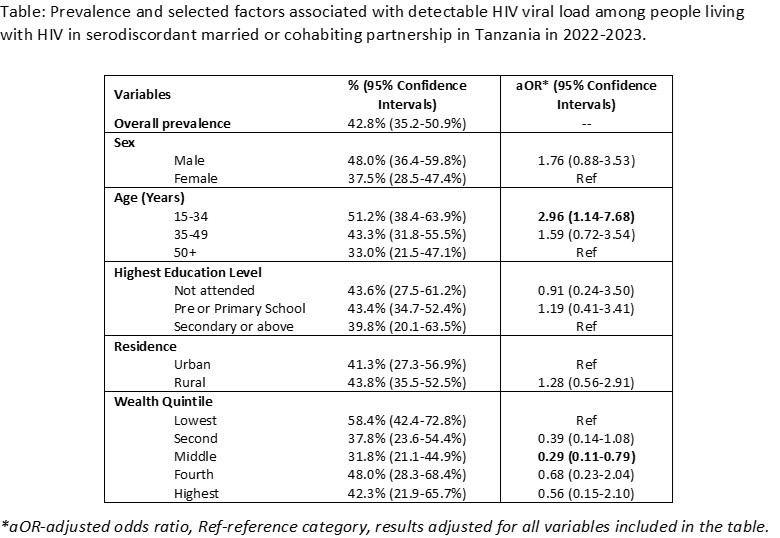
Among 1,850 PLHIV identified in THIS, 51.6% (48.6-54.7%) were married or cohabiting. Of those, 61.4% (57.0-65.5%) had a recent sexual partner with a recorded THIS HIV test result, and 46.1% (39.7-52.7%) of those partners had a negative HIV test result. Of 261 SD-PLHIV analyzed, median age was 39 years (interquartile range: 31-48), and 51.3% (42.9-59.5%) were female. Overall, 42.8% (35.2-50.9%) of SD-PLHIV had DVL (Table). Prevalence of DVL decreased by age category; 15-34 years: 51.2% (38.4-63.9%), 35-49 years: 43.3% (31.8-55.5%), and ≥50 years: 33.0% (21.5-47.1%). DVL was significantly higher among SD-PLHIV aged 15-34 years (aOR 3.0 [1.1-7.7]) compared to those aged ≥50 years (Table). Sex, education, and residence were not associated with DVL.
Conclusions
We observed high prevalence of DVL among SD-PLHIV in our analysis. Programs focused on improving awareness of HIV prevention interventions for serodiscordant married or cohabiting partners and tailored interventions focusing on PLHIV 15-34 years might improve HIV viral load suppression among SD-PLHIV.
Table or Figure