Background
In late 2019, pre-exposure prophylaxis (PrEP) for HIV infection was approved in Spain, potentially altering HIV-1 molecular epidemiology and reducing the number of new infections within transmission chains (TCs). We aimed to analyze the presence and characteristics of TCs in newly diagnosed HIV-1 patients before and after PrEP implementation, and to assess the prevalence of transmitted drug resistance (TDR) to antirretroviral therapy (ART) and its association with TCs.
Methods
Monocentric study, comparing new HIV-1 diagnoses before and after PrEP implementation (2016-2019 vs. 2020-2023). Sequences of HIV-1 retrotranscriptase and protease were analyzed. Phylogeny was inferred with FastTree, and subtyping with REGA and COMET. Sociodemographic, clinical, immunovirological characteristics and TDR mutations were also analysed. Statistic program: SPSS v24.
Results
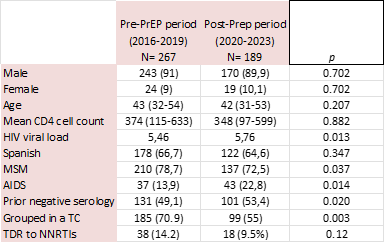
456 new HIV-1 diagnoses were included. Globally, 413 (90.6%) were men, 347 (84%) having sex with men, and 300 (65.8%) Spanish, with a mean age of 43 (32-54) years; the more frequent subtypes were B (269, 59%) and CRF02_AG (29, 6.4%). Features of subjects diagnosed in the pre-PrEP and post-PrEP periods are shown in Table 1. After PrEP implementation, the percentage of MSM among all new HIV-diagnoses decreased (78.7 vs 72.5%; p=0.037), and AIDS cases increased (13.9 vs 22.8%; p= 0.014); a prior negative serology existed in 49,1% vs 53.4%, p=0.02. During pre-PrEP period, 70.9% of patients grouped in a TC vs 55% in the post-PrEP period (p=0.003).
Conclusions
HIV-1 diagnoses have declined in recent years, with a decrease of MSM among all new patients and more AIDS cases after PrEP implementation. These differences in addition to a decrease in TCs suggests that PrEP may have reduced transmission within groups. TDR to NNRTIs remained stable, emphasizing the need for ongoing monitoring of resistance patterns.
Table or Figure