Background
Osteoporosis is common in postmenopausal women with HIV (WWH). Guidelines recommend bone mineral density (BMD) screening by dual-energy X-ray absorptiometry (DXA) for all postmenopausal WWH; yet osteoporosis screening rates remain low. We evaluated the Ultrascan™650 (CyberLogic), a portable, affordable quantitative ultrasound device (QUS-BMD), as an alternative for BMD screening in outpatient settings.
Methods
We assessed BMD in 261 women, 177 with HIV (WWH) and 84 without HIV (WWoH) age >40 years enrolled in the Chicago Cook County Site of the MWCCS. We assessed the women’s non-dominant distal radius using the QUS-BMD (evaluation cohort). Nearly 40% (n=99) had paired (DXA & QUS) BMD assessments (validation cohort). DXA-based measurements were obtained for lumbar spine, femoral neck and total hip, while 36 women also had distal radius measurements to match the QUS-BMD site. In the validation cohort, we determined the association between DXA and QUS-based BMD using Pearson’s correlation. In the evaluation cohort, we compared BMD prevalence by HIV-serostatus and tested associations between QUS-BMD and osteoporosis risk factors. Significant factors in bivariate analyses (p<0.1) were then entered in multivariate models adjusted for HIV-serostatus and run separately in pre- and post-menopausal women.
Results
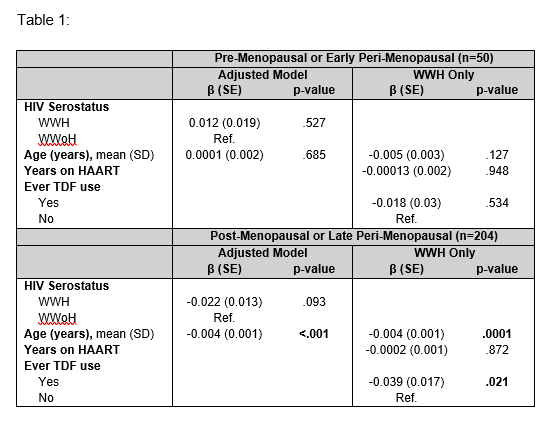
The strongest correlation between US and DXA-based BMD existed for matched distal radius measurements (r=0.76; p<0.001) while additional sites were moderately correlated with QUS BMD including femoral neck (r=0.59, p<0.001), total hip (r=0.54, p<0.001), and lumbar spine (r=0.36, p<0.001). Women in the evaluation cohort were predominantly Black (83%) and postmenopausal (76%). WWH had higher rates of osteoporosis than WWoH (27.7% vs. 15.5%,p=0.09). In bivariate analyses, older age (β=-0.004, p<0.001) and later menopausal stage (β=-0.057, p<0.001) were significantly associated with lower QUS-BMD. Among WWH, higher nadir CD4 (β=0.0001, p=0.012) and TDF use (β=-0.036, p=0.007) were also associated with lower BMD. In multivariable models, QUS-BMD was not associated with age or HIV status in premenopausal women; however, among postmenopausal women, lower QUS-BMD was independently associated with older age and TDF use in WWH (Table 1).
Conclusions
Portable QUS-BMD was correlated with DXA-based BMD. The Ultrascan™650 is a cost-effective osteoporosis screening tool in research and clinical settings and may help improve early identification of osteoporosis and subsequent management.
Table or Figure