Background
Syphilis incidence in the United States has risen sharply over the past two decades, especially among men who have sex with men (MSM), when cases declined following the rollout of Doxycycline post-exposure prophylaxis (doxy-PEP). Doxy-PEP has been shown to reduce syphilis acquisition risk in clinical trials, but its potential population-level impact remains unclear. We sought to estimate the effect of a broad roll-out of doxy-PEP among MSM on syphilis transmission in New York City, Miami, Atlanta, and Baltimore.
Methods
Using the SHIELD model – a dynamic compartmental model of syphilis transmission calibrated to local population demographics and syphilis diagnoses from 1993–2022 by sex, race, and disease stage – we simulated three scenarios beginning in 2022: (1) no doxy-PEP coverage; (2) 10% doxy-PEP uptake among MSM by 2027; (3) 25% doxy-PEP by 2027. We assumed doxy-PEP efficacy ranged from 52% to 92%, consistent with clinical trials. The primary outcomes include projected cumulative incident infections averted and primary/secondary diagnoses averted under doxy-PEP scenarios relative to the no-doxy-PEP scenario.
Results
In the absence of doxy-PEP, the model projected 260,975 (147,380–470,982) new infections from 2022–2030 across the four cities. Increasing doxy-PEP coverage to 10% among MSM was projected to reduce incident syphilis infections by 41% (31–51%) by 2030. At 25% coverage, 62% (52-73%) of incident infections would be averted.
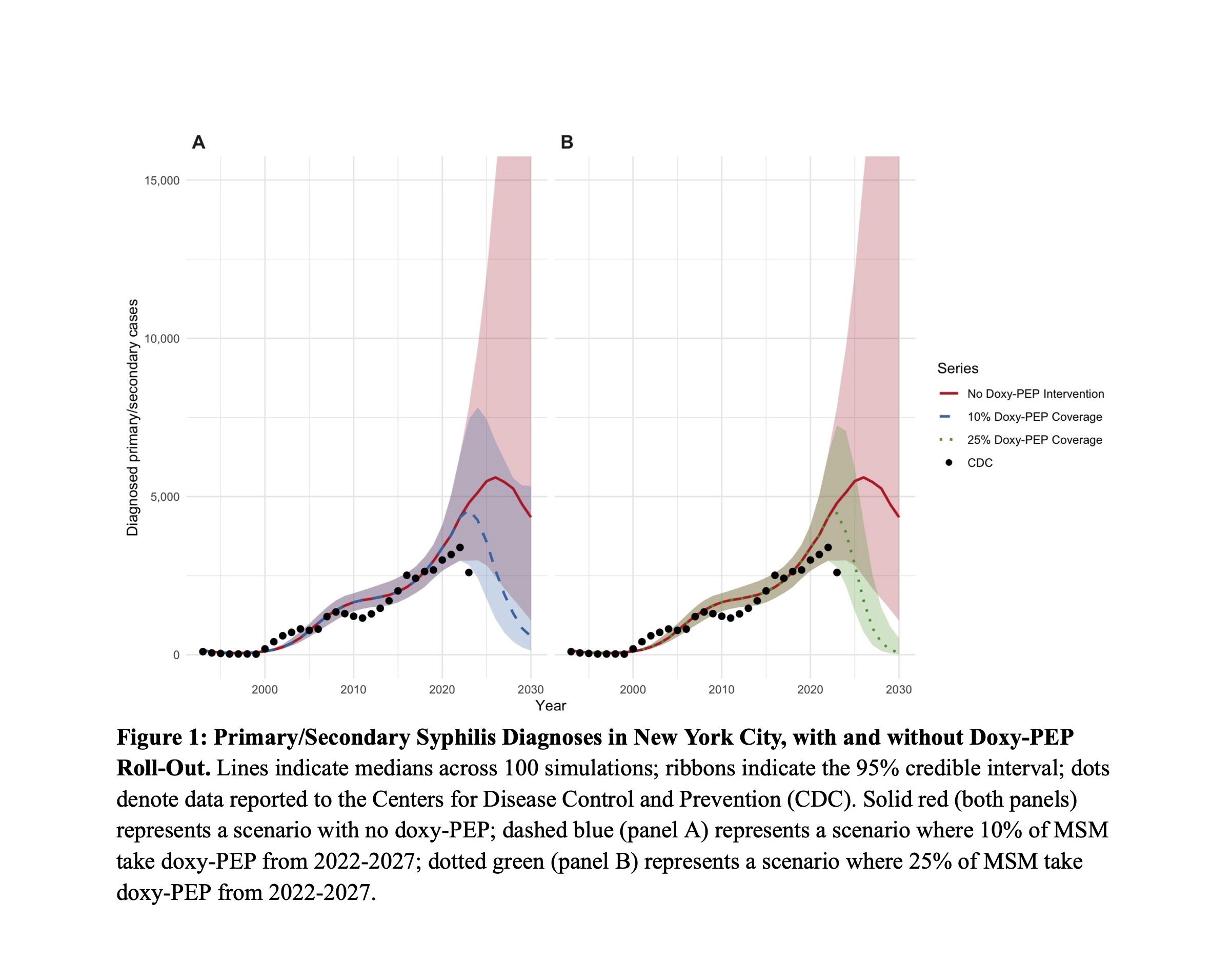
Doxy-PEP roll-out had a similar impact on primary/secondary syphilis diagnoses across the four cities. Under 10% doxy-PEP coverage, projected reductions in diagnoses ranged from 35% (24-49%) in Miami to 39% (29-57%) in New York City. At 25% coverage, reductions ranged from 57% (41-72%) in Miami to 59% (47–79%) in New York City (see Figure for New York City).
Conclusions
Doxy-PEP has the potential to substantially reduce syphilis incidence, even at relatively low and targeted population coverage.
Table or Figure