Background
Although antiretroviral therapy (ART) inhibits HIV-1 replication and suppresses plasma HIV-1 RNA to below the clinical assay limit of detection (20-40 copies(cp)/mL), low-level viremia (LLV) can still be detected by more sensitive, single-copy assays (SCAs). Screening for changes in LLV after curative interventions could provide a simple, high-throughput indicator of initial evidence of potential reservoir effects. However, further insight is needed about the longitudinal detection and stability of LLV to determine whether changes in LLV result from assay or biologic variation or the impact of an intervention.
Methods
We conducted an observational, longitudinal study to assess the stability of LLV in people with HIV-1 on suppressive ART. Enrolled participants were on ART for at least 5 years with plasma HIV-1 RNA <40 cp/mL for at least 72 weeks and were not screened for LLV prior to enrollment. Plasma samples were collected at screening, weekly for 4 weeks, and every 4 weeks until week 24. HIV-1 RNA over 10 timepoints spanning 6 months was measured in 5 mL of plasma by automated SCA (Jacobs, J Clin Micro 2019) and analyzed by linear regression and linear mixed effects modeling.
Results
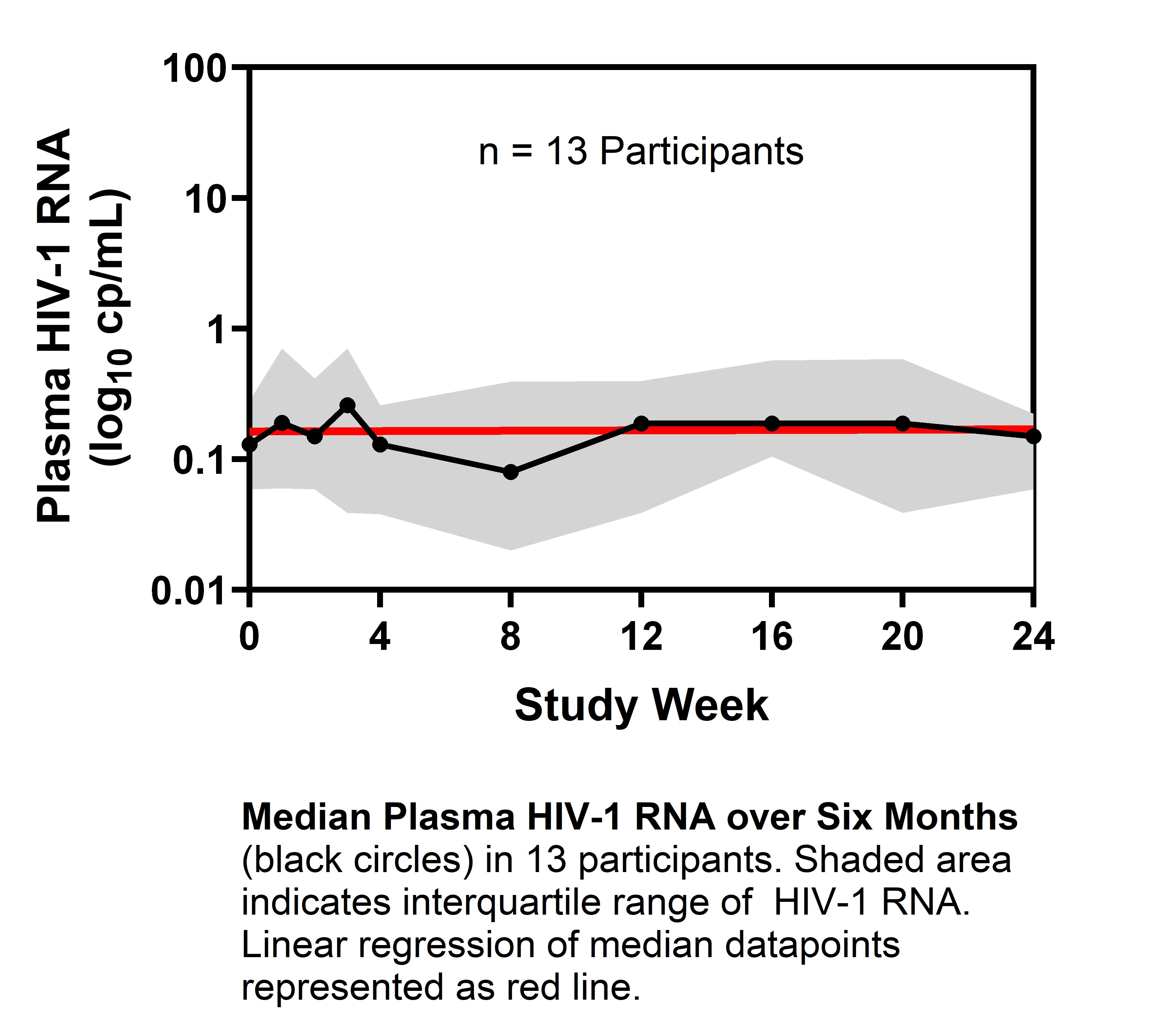
Thirteen participants (9 male, 4 female; 62% Black, 38% Caucasian; median age: 62; interquartile range: 57-66) have completed the study. Plasma HIV-1 RNA was detected in 116/130 (89%) samples evaluated. Eleven participants (8 male, 3 female) had detectable HIV-1 RNA at ≥8 timepoints and 8 participants (6 male, 2 female) at all 10 timepoints. One participant had undetectable HIV-1 RNA at entry and 7 subsequent timepoints. The slopes of plasma HIV-1 RNA from the study population (Figure) and each participant over the study timepoints were not significantly different from zero (p = 0.26 by linear mixed effects modeling), indicating that LLV remained stable across participants.
Conclusions
Our results demonstrate that LLV on ART is stable over 6 months using a sensitive, high-throughput assay. Further studies will assess to what extent post-intervention changes in cellular HIV-1 reservoirs are reflected in plasma HIV-1 RNA. These findings highlight the potential for changes in LLV to provide an initial signal of the in vivo activity of therapeutic interventions for subsequent in-depth characterization.
Table or Figure