Background
As the population of women living with HIV (WWH) ages, an increasing number of WWH are experiencing menopause. WWH are at increased risk for menopausal comorbidities, including cardiovascular disease (CVD) and osteoporosis. The objective of this analysis was to examine the association between HRT use and comorbid conditions, metabolic measures, and menopausal symptoms among WWH in a large urban cohort.
Methods
Data for this study come from the DC Cohort Longitudinal HIV Study using electronic health record data (2011-2025) among WWH ≥40 years. We compared participant characteristics, HIV labs, comorbidities (CVD, osteoporosis), metabolic measures, and menopausal symptoms (musculoskeletal symptoms, sleep disturbances, urogenital symptoms; pre-HRT initiation vs end of follow up for non-HRT) between WWH with and without HRT prescriptions using bivariable analysis. Associations between HRT use and comorbid conditions, metabolic measures, and menopausal symptoms were assessed using unadjusted and adjusted logistic and linear regression models.
Results
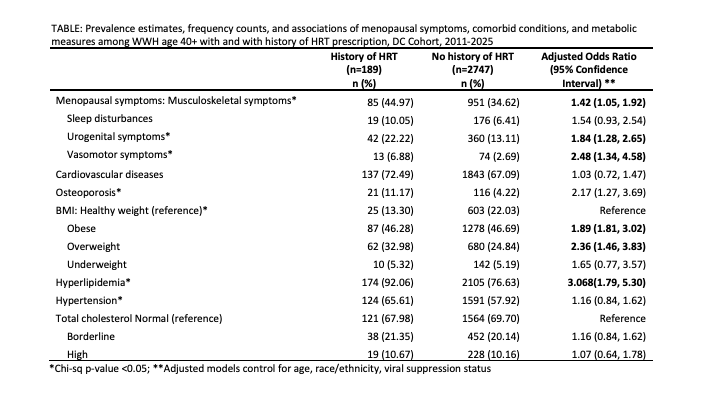
Among 2,936 WWH, 189 (6.4%) had a history of HRT prescription. WWH on HRT were mean age 61 years old, majority non-Hispanic Black (88%), and 89% virally suppressed (HIV RNA <200 copies/mL). WWH with HRT had greater prevalence of osteoporosis compared to WWH not on HRT (11% vs 4%, respectively, p<0.05); no differences were found for CVD (72% vs 67%, respectively, p>0.05). Compared with those not on HRT, WWH on HRT had greater odds of reporting pre-HRT menopausal symptoms including musculoskeletal symptoms (adjusted odds ratio [aOR]=1.42, 95%CI= 1.05, 1.92), urogenital symptoms (aOR=1.84, 95%CI= 1.28, 2.65), and vasomotor symptoms (aOR=2.48, 95%CI= 1.34, 4.58) in models adjusting for age, race/ethnicity, and viral suppression status. HRT was associated with increased odds for osteoporosis (aoR=2.17, 95% CI=1.27,3.69), obesity (aOR=1.89, 95%CI=1.81, 3.02) and overweight (aOR=2.36, 95%CI=1.46, 3.83). Some metabolic measures were greater among WWH on HRT compared to WWH without (triglycerides mean(SD)=130.25(75) vs 119.60(73), p=0.05); albumin mean(SD)=4.18(0.44) vs 4.11(0.44), p=0.004) in bivariable analyses, though these associations were did not remain statistically significant in linear regression models.
Conclusions
Our analysis found that HRT use among WWH ³40 was associated with an increased odds of comorbidities and pre-HRT menopausal symptoms. These results suggest the need to further investigate benefits and risks of HRT use among WWH.
Table or Figure