Background
People who inject drugs (PWID) face high morbidity and mortality from addiction and HIV. This abstract reports findings from HPTN 094 on whether 26 weeks of “one stop” integrated health services delivered in a mobile unit, supported by peer navigation, improves use of MOUD, increases viral suppression among people with HIV (PWH), and increases use of pre-exposure prophylaxis (PrEP) among people without HIV (PWOH) compared to 26 weeks of peer navigation to local services.
Methods
HPTN 094 is a 26-week, HIV serostatus-neutral, randomized controlled trial with follow-up through 52 weeks conducted in Houston, Los Angeles, New York, Philadelphia, and Washington DC. Study arms: Experimental: Integrated services delivered in a mobile unit with peer navigation and transition to local services at 26 weeks; Active control: Peer navigation to existing local services throughout. Integrated services were: tenofovir-based PrEP for PWOH; antiretroviral therapy (ART) for PWH, MOUD, screening/treatment/referral for STIs and HCV, basic primary care, referrals for housing, food, and social services. Eligibility: reported HIV sexual/drug-related risks for PWOH with OUD; not on, but willing to start MOUD. Primary outcomes at 26 weeks: alive, taking HIV PrEP or ART (verified by blood), and being on MOUD (verified by urine plus evidence of being on MOUD). Generalized Linear Models estimated primary and certain secondary outcomes with arm and site as covariates; Cox proportional hazards modeled death outcomes.
Results
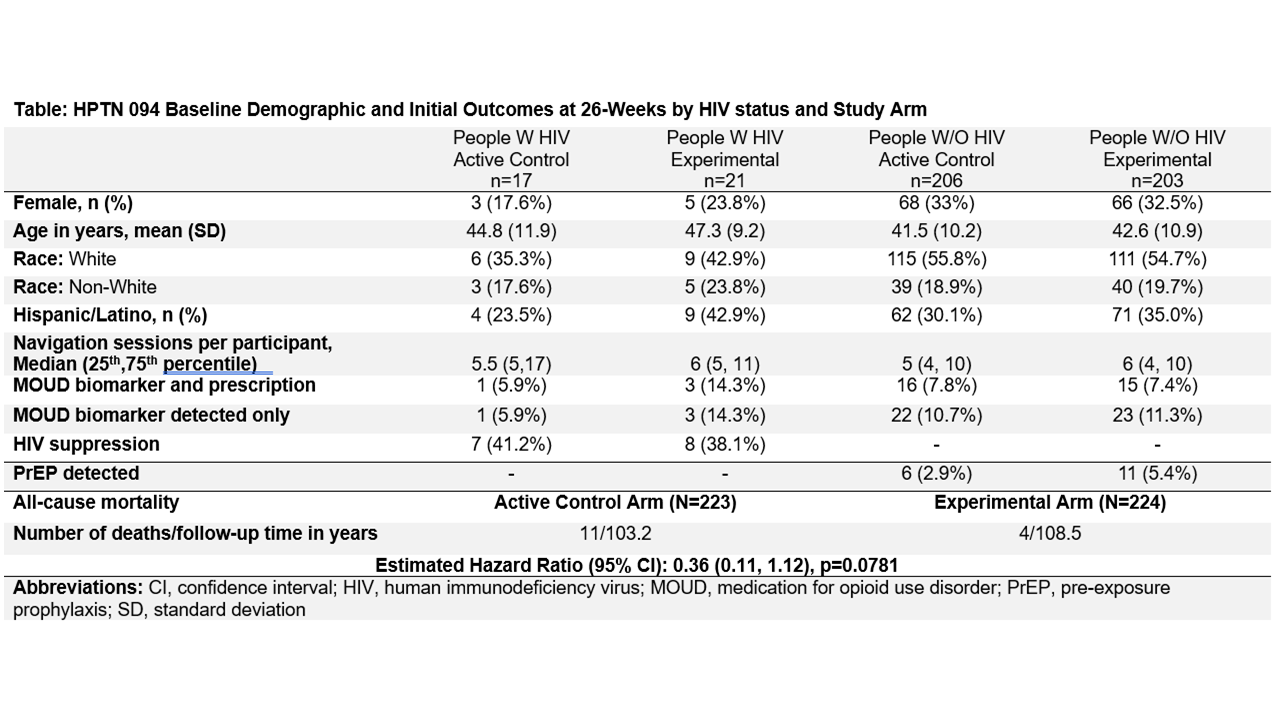
Table presents demographics, primary and secondary outcomes by serostatus and study arm. There were no significant differences in primary outcomes at 26 weeks, with low evidence of MOUD use across arms and serostatus. There was no difference in HIV-1 RNA suppression by study arm among PWH; no difference in PrEP use among PWOH at the 26-week visit. HIV seroincidence among PWOH was 0.92 per 100PY. Uptake of peer navigation was high in both arms. A 64% reduction in all-cause mortality was observed for experimental vs. active control arms but, did not reach statistical significance.
Conclusions
The strong reduction in all-cause mortality for the integrated services vs. control arm signals the likely value of delivering this care strategy to PWID using a mobile unit. Findings suggest that reaching and engaging PWID in need of comprehensive care “where they are at” may prevent deaths and highlights the potential power of the HPTN 094 mobile unit in addressing multiple health crises simultaneously.
Table or Figure