Background
Dual therapies, particularly the DTG/3TC combination, are now recommended by the WHO as an alternative to TDF-based triple ART for virologically controlled patients. We have worked on the issue of weight gain under dual therapy in sub-Saharan Africa.
Methods
We conducted a study in three subsaharian Africa countries, randomizing HIV-1 adults on TDF+3TC+EFV (TLE) for ≥2 years, without prior virological failure, and with BMI data at all visits. We compared changes in weight between those switching to dual therapy and those continuing triple ART, using mixed-model repeated measures, and we assessed the prognostic factors associated with weight gain of more than 10% between baseline and W96 using the binary logistic regression.
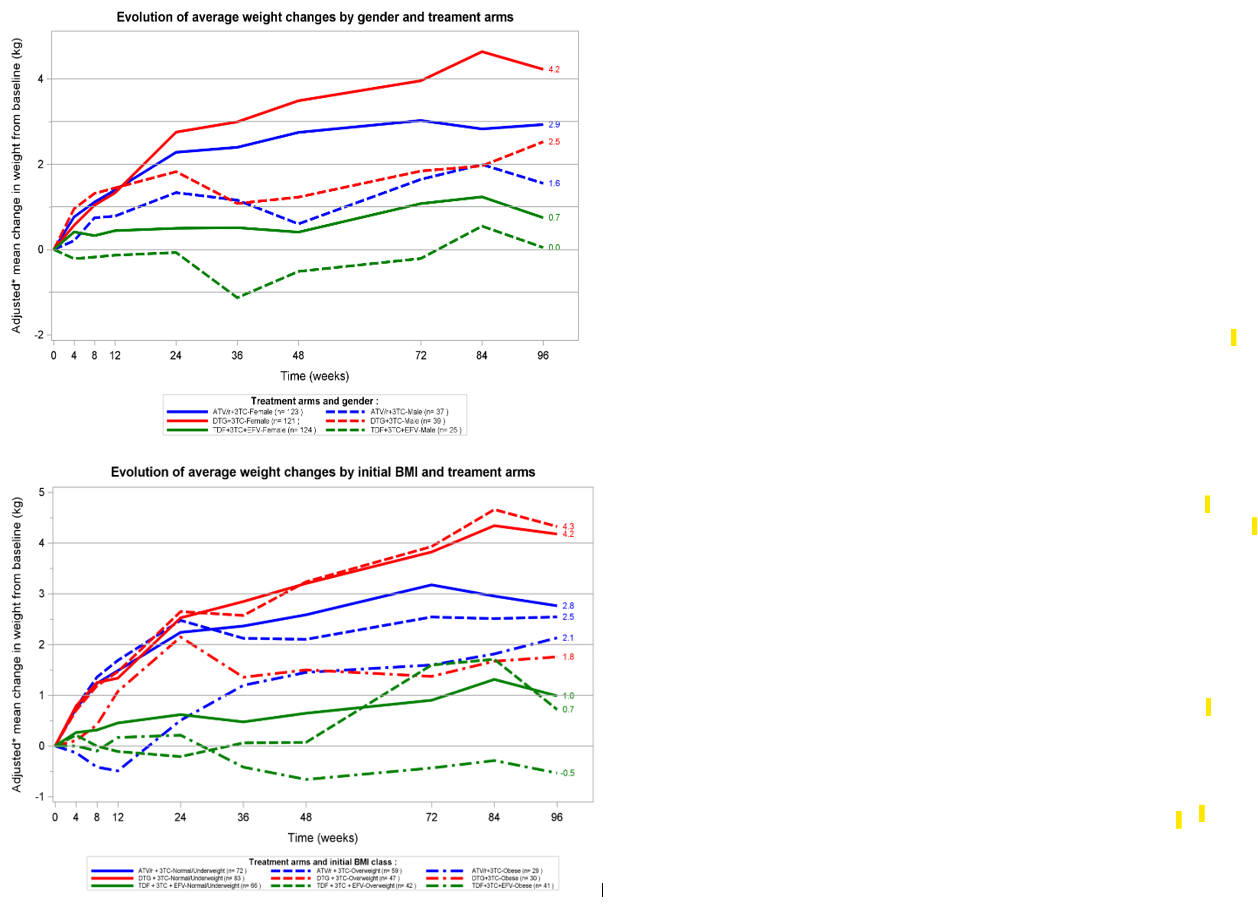
The change in mean weight from baseline was calculated adjusting for visit, baseline BMI, treatment arm, sex, age (continuous), baseline CD4 count, duration of ART(continuous), interactions between visit and treatment arm, and baseline BMI with treatment arm.
Results
A total of 469 adults (78% women, 22% men) were randomized: 68% to dual therapy and 32% to triple therapy, with 96 weeks of follow-up. Median age was 50 years (21–76), 46% between 45–55. Baseline median weight was 69 kg (37–138) and median BMI 25 kg/m² (16–49). By BMI, 40% were normal weight (42% DTG+3TC, 40% ATV/r+3TC, 39% TLE), 31% overweight (29%, 36%, 27% respectively) and 21% obese (18% in each dual arm, 27% TLE). Participants had been on ARVs for a mean of 9 years, including 6 years on TLE.
Weight gain >10% between baseline and week 96 was observed in 23% of dual therapy patients (25% DTG+3TC, 21% ATV/r+3TC) versus 7% with TLE. After adjustment in a multivariable logistic regression model, prognostic factors associated with weight gain >10% included study treatment (aOR[95%CI] ATV/r+3TC vs TLE = 3.8 [1.7–8.2]; DTG+3TC vs TLE = 5.1 [2.4–10.9]), baseline BMI (Underweight/Normal vs Obese = 5.2 [2.1–12.9]; Overweight vs Obese = 2.8 [1.1–7.4]), gender (Female vs Male = 2.7 [1.3–5.6]) and ART duration (≤5 years vs ≥10 years = 1.9 [1.1–3.4]).
Conclusions
Switching to dual maintenance therapy without Tenofovir has a favorable safety profile at W96. WHO has introduced DTG/3TC as a recommendation in switch strategies for patients with virological control. However, we have observed that with the following prognostic factors, such as female gender, having a Underweight/normal or overweight BMI, or being on ART for less than 5 years, there is a greater risk of weight gain with the switch to dual therapy.
Table or Figure