Background
The disparate geography of HIV and hepatitis C (HCV) in the United States has yet to be fully explained. We therefore assessed the mediated influence of rurality on rates of new HIV, HCV, and HIV/HCV diagnoses in Tennessee (TN), a largely rural state.
Methods
We conducted an ecological study from 2018–2023 using longitudinal surveillance data on those aged ≥16 years, diagnosed with HIV, HCV, or both. Our exposure, rurality, was defined as percentage of county population in non-urban areas in the 2020 US Census. Our outcomes were annual county counts of people with newly diagnosed HIV, laboratory-defined incident HCV (excluding those incarcerated at incident date), or both HIV and HCV (earliest date with both HIV and HCV confirmed). We used Poisson models with generalized estimating equations and county population offsets to estimate incidence rate ratios (IRRs) and 95% confidence intervals (CI) for the Total Effect (ET) and Direct Effect (ED; the effect not mediated, also equivalent to ET minus the mediated effect) of rurality on our outcomes. We estimated ED using year of diagnosis, primary care physician (PCP) density, chlamydia rate, and Social Vulnerability Index (SVI) data from the County Health Rankings and the CDC as modifiable markers of community health and socioeconomics.
Results
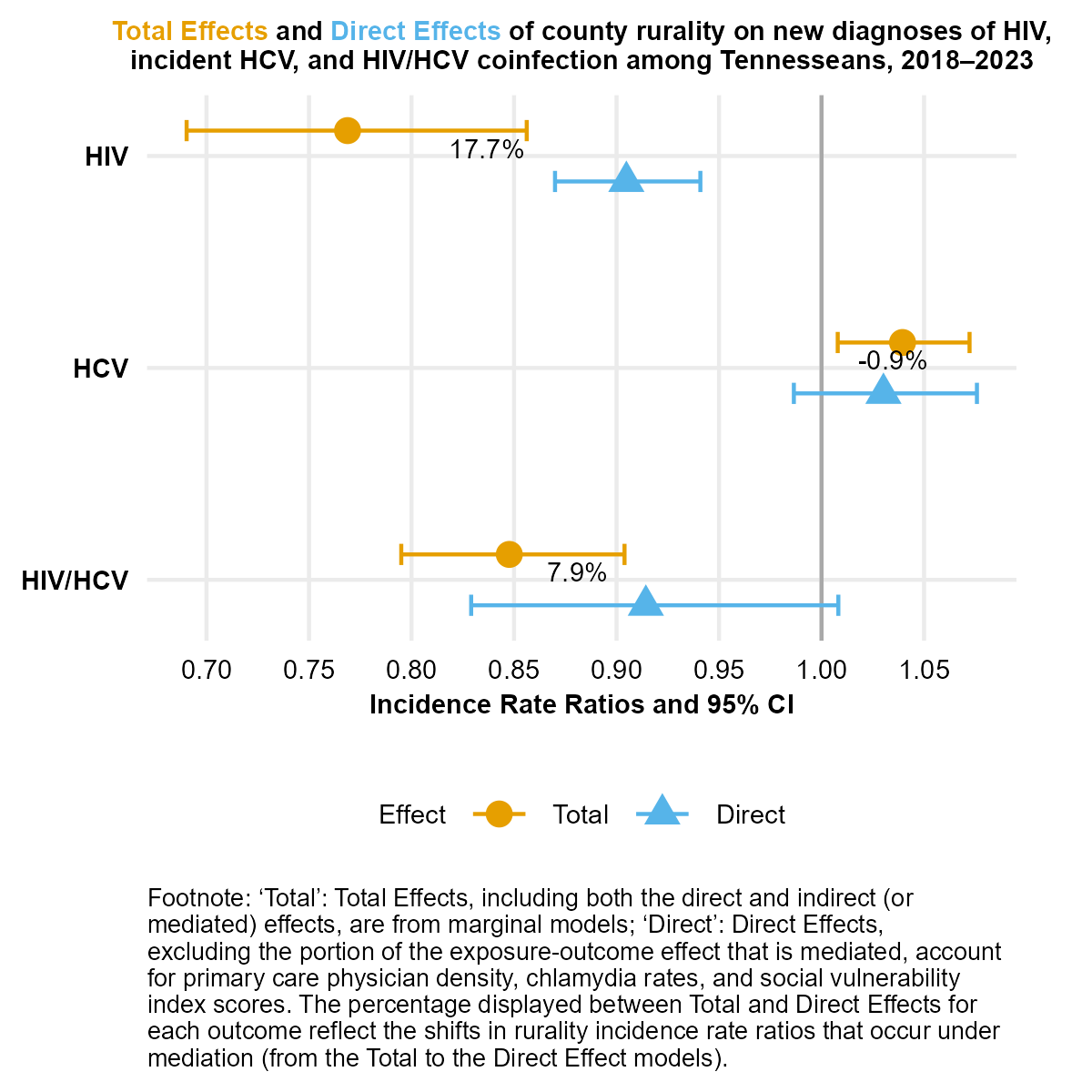
Across all 95 TN counties, median rurality was 71.3% (interquartile range [IQR]: 51.8%, 100%); county HIV (0.0–49.2) and HCV (19.0–1338.0) rates per 100,000 varied widely. Median PCP density (46.5, IQR: 29.6, 64.4) and chlamydia rates (404.0, IQR: 305.0, 550.0) per 100,000 were higher in urban areas, while SVI scores were higher in rural areas. The ET per 10% increase in rurality was a 23.1% decrease in HIV rates (IRR=0.77; CI: 0.69–0.86), a 4.0% increase in HCV rates (IRR=1.04; CI: 1.01–1.07), and a 15.2% decrease in HIV/HCV rates (IRR=0.85; CI: 0.80–0.90; Figure). The ED per 10% increase in rurality was a 9.5% decrease in HIV rates (IRR=0.90; CI: 0.87–0.94) but a null relationship with HCV (IRR=1.03; CI: 0.99–1.08) and HIV/HCV rates (IRR=0.91; CI: 0.83–1.01) after accounting for mediation (Figure). The ET was attenuated 17.7% for HIV and 0.9% for HCV in the ED.
Conclusions
Rurality’s effect on HIV risk was attenuated, and on HCV risk was nullified, after accounting for modifiable mediating factors in a southern US state. Our findings suggest HIV and HCV prevention should be strengthened in areas with poor healthcare access or high socioeconomic vulnerability to narrow rural-urban disparities.
Table or Figure